
As a mid career professional, you’re earning well, contributing to EPF every month, and perhaps running a few investments on the side. Yet somewhere in the back of your mind sits a quiet, nagging question: is all of this going to be enough? This retirement roadmap for mid‑career professionals explains the benchmarks, strategies and 12‑month actions that turn concern into a workable plan, asked at the right moment in your 40s or early 50s.
Ages 35 to 55 represent the accumulation phase of any serious retirement plan. This is the window where catching up remains realistic, compounding still pulls its weight, and deliberate decisions carry the most impact. But it’s also the stage where passive optimism stops being a strategy. A real mid‑career retirement plan should cover specific ground: savings benchmarks, portfolio structure, income‑replacement modelling, and a protection review.
Working through all of this is what an independent, fee‑only financial planner does alongside you. If you’re a professional aged 35 to 55 who wants that clarity, this guide covers the full retirement roadmap framework from benchmarks to a 12‑month action plan.
Table of Contents
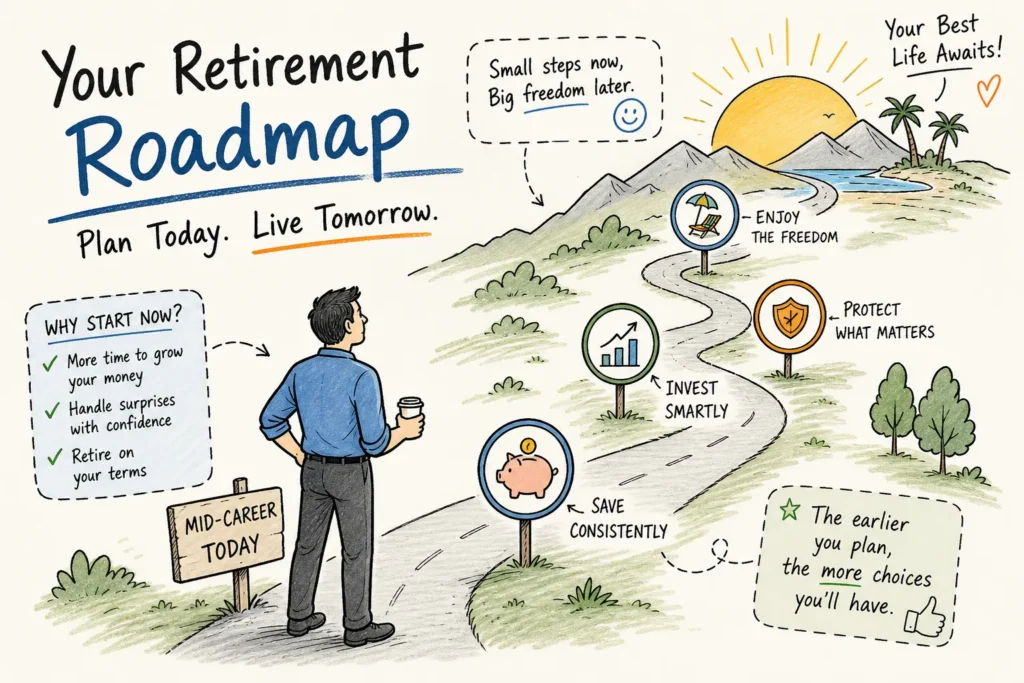
Where you actually stand: retirement roadmap for mid‑career professionals, benchmarks by age
The salary‑multiple framework is a practical starting point for assessing retirement readiness. As a guide, target 1× your annual salary by age 35, 4, 6× by age 45, and 7, 10× by age 55. These ranges are commonly used by planners to support a 70, 80 per cent income‑replacement rate through retirement, noting that Malaysia’s public‑scheme replacement expectations are typically lower (research places Malaysia’s gross pension replacement rate around 38 per cent). Treat 70, 80 per cent as a general benchmark to be adjusted to your household needs and lifestyle assumptions.
In ringgit terms, a professional earning RM12,000 per month (RM144,000 annually) should have roughly RM576,000 to RM864,000 in total accumulated savings by age 45. Against EPF’s published data, average balances are materially lower: at end‑2023, members aged 45, 49 had an average RM121,287 and those aged 50, 54 had RM137,903. The gap suggests EPF alone is unlikely to meet higher replacement‑rate goals without additional savings and investments. [Source: EPF Annual Report/Statistics 2023]
The combined statutory contribution rate of 23, 24 per cent (11 per cent employee and 12, 13 per cent employer) is a solid foundation, but it rarely closes the gap, especially for professionals who took career breaks, withdrew EPF for housing, or started contributing later than ideal. Your personal readiness score is simple to calculate: divide your current total savings by your annual salary and compare the result with the age benchmark. That number gives you an honest, unemotional baseline and a focused starting point for the work ahead.
Accelerating savings when the window feels narrow
The most tax‑efficient move many mid‑career Malaysians underuse is voluntary EPF contributions above the mandatory 11 per cent. Employee EPF contributions (including voluntary top‑ups) generally qualify for personal tax relief up to the annual EPF relief cap set by LHDN for that year; check the latest Inland Revenue Board guidance for current limits and eligibility, especially if you’re self‑employed or contributing on behalf of a spouse. EPF’s i‑Invest and Members’ Investment Scheme (MIS) also allow members to diversify a portion into unit trusts and other assets to seek higher long‑term growth.
The Private Retirement Scheme (PRS) is a complementary layer. Contributions currently attract dedicated personal tax relief of up to RM3,000 per year, investment gains within PRS are tax‑exempt, and fund choices can be calibrated to your risk profile and horizon. PRS doesn’t replace EPF; it extends your tax‑advantaged capacity over a 15, 20 year accumulation window. The PRS tax relief has been extended through to YA 2030.
Mid‑life retirement planning levers: cashflow to contribution
The practical constraint is usually cashflow. Before accelerating contributions, clear high‑interest debt first. Credit card balances and personal loans typically charge rates that exceed likely investment returns, so eliminating these frees up sustainable capacity. Once cleared, redirect those repayments directly into EPF voluntary top‑ups or a PRS account. Even a 3, 5 per cent increase in savings rate, sustained over 15 years, compounds meaningfully. For example, on a RM12,000 monthly salary, an extra 3 per cent saved (~RM360/month) invested at 5 per cent annually could accumulate around RM93,000 in 15 years; 5 per cent (~RM600/month) could reach about RM155,000, on top of your base savings. Assumptions: level contributions, 5 per cent nominal return, 15‑year horizon.
Building a portfolio that grows over the next 15, 25 years
Asset allocation is where many mid‑career professionals make their costliest mistake: being too conservative too early. With 15 or more years to retirement, portfolios can typically hold a high share in growth assets (equities, equity unit trusts, ETFs), with the exact range tailored to risk capacity, guaranteed‑income sources, and rebalancing discipline. A bond‑heavy stance during accumulation sacrifices compounding that’s hard to recover later.
Most Malaysian mid‑career professionals hold the bulk of their private wealth inside EPF. That’s a reliable foundation, EPF has delivered mid‑single‑digit dividends in recent years, but it shouldn’t be the entire picture. Diversifying into listed equities, REITs, and equity funds introduces growth potential that can extend the retirement runway. A well‑structured portfolio targeting around 6, 7 per cent nominal, against an inflation assumption of 4, 5 per cent annually, aims to preserve real purchasing power. Always adjust for your own risk tolerance and cashflow needs.
Accumulation‑phase investment plan
With 15, 25 years to go, tilt toward growth and automate contributions. Use low‑cost funds where possible, rebalance annually, and avoid performance‑chasing. Keep emergency cash separate from investments to reduce the temptation to de‑risk prematurely.
Glide path to retirement
As you move within 10, 15 years of retirement, begin a gradual transition toward a 70, 80 per cent growth and 20, 30 per cent defensive mix. This glide path is about managing sequence‑of‑return risk as the drawdown phase approaches. Annual reviews should align to your age and remaining timeline, not short‑term market noise.
The income replacement gap that sneaks up on professionals
A concrete scenario helps. Suppose a 45‑year‑old targets RM7,000 per month in today’s ringgit from age 60 for 25 years. That’s RM84,000 per year in real (today’s) terms. If we assume a 0, 2 per cent real return (after inflation) in drawdown, the present value needed at retirement ranges from roughly RM2.1 million (0 per cent real; RM84,000 × 25) to about RM1.64, 1.74 million (1.5, 2 per cent real, using standard annuity‑present‑value maths). Adding a prudent buffer for sequence‑of‑return risk and contingencies can lift the target toward RM2.0, 2.5 million. Your actual number shifts depending on how much EPF, PRS, and private investments already cover. [Assumptions shown; methods consistent with retirement‑income research such as safe‑withdrawal‑rate studies]
Modelling assumptions matter. Use 5, 6 per cent as a long‑term nominal return and 4, 5 per cent as the inflation rate for base‑case planning, grounded in EPF’s historical range and Malaysian CPI trends. A nominal portfolio of RM1.5 million looks very different in purchasing power after 20 years if inflation averages 5 per cent annually. Planning for a 25‑plus‑year retirement runway, given Malaysian life expectancy past 76 years, is a realistic baseline for anyone retiring in their early 60s. [Sources: EPF dividend history; DOSM CPI; DOSM life expectancy]
Healthcare costs deserve a dedicated line in any retirement model. For a retiree aged 65, projected private healthcare costs over 20 years can range from roughly RM300,000 to well above RM800,000, depending on medical inflation, plan limits, and major‑illness events. Building a healthcare reserve alongside the core portfolio, funded through a combination of medical insurance and ring‑fenced savings, helps prevent a single health event from dismantling a plan decades in the making. For local cost estimates and medical insurance pricing references see the Malaysia medical insurance cost guide. Medical insurance cost estimates in Malaysia provide helpful context when sizing a healthcare reserve.
Insurance review: the protection layer mid‑career plans often skip
Insurance needs shift considerably between age 35 and 55. At 35, the priority is income replacement for dependants through life coverage. By 45, 55, critical‑illness protection often takes precedence as health risks rise, while life sum assured can sometimes be scaled back as mortgages reduce and dependants become financially independent. The challenge is many mid‑career professionals haven’t reviewed coverage since purchase, leaving them either over‑paying for outdated life policies or under‑insured for critical illness and medical costs. See our Retirement Roadmapping & Scenario Analysis using AI (Malaysian with Too Many Insurance Policies) for a practical example of trimming redundant coverage while preserving protection for core risks.
A structured review should cover three checkpoints. First, life coverage sufficient to clear debts and provide an income bridge, rules of thumb often cite 10× annual income, but tailor this to your liabilities and assets. Second, critical‑illness coverage sized to replace 2, 3 years of income during treatment and recovery; again, treat this as a starting heuristic, not a prescription. Third, a medical card with adequate annual and lifetime limits for private hospital care. Note that employer group medical cover typically ends when employment ends or at retirement; buying private medical coverage while you’re in good health is usually cheaper and easier under underwriting than applying later with pre‑existing conditions.
Turning the retirement roadmapping for mid‑career professionals into a 12‑month plan
A six‑step sequence gives this roadmap structure and forward momentum. First, establish your current readiness baseline using the salary‑multiple calculation. Second, clear high‑cost debt to free up genuine contribution capacity. Third, maximise voluntary EPF contributions and open a PRS account if you don’t have one, capturing available tax relief. Fourth, build a diversified portfolio aligned to your time horizon, with the equity weighting appropriate for your years to retirement. Fifth, complete a full insurance review and right‑size coverage for the mid‑career risk profile. Sixth, model the full income‑replacement gap using realistic return and inflation assumptions, then stress‑test the projection.
Milestones convert good intentions into a working plan with accountability. Use the markers below to pace progress and keep decisions tied to dates, not moods:
- Month 1: Complete the salary‑multiple self‑assessment and calculate your current gap against the benchmark for your age. Try our freesalary‑multiple calculator.
- Month 3: Restructure EPF voluntary contributions and initiate a PRS account if applicable. Read our guide:EPF vs PRS: building a tax‑smart accumulation plan.
- Month 6: Complete the insurance review and close any critical‑illness or medical‑coverage gaps identified.
- Month 12: Model the full retirement projection and stress‑test it against a 4 per cent inflation scenario to see the range of outcomes.
Pre‑retirement checklist
- Document your target retirement age, lifestyle budget, and desired replacement rate.
- List EPF/PRS balances, private investments, and expected liabilities at retirement.
- Confirm medical card annual/lifetime limits and exclusions; note renewal terms.
- Set contribution amounts and review dates in your calendar for the next 12 months.
This is where a fee‑only planner makes a measurable difference. Every good engagement should deliver these outputs: a quantified income‑replacement gap, an optimised EPF and PRS strategy, right‑sized insurance coverage, and a portfolio matched to your timeline. To discuss your plan with an independent adviser, book a free retirement planning assessment. The flat‑fee model ensures recommendations reflect your situation, not a product commission.
Build the plan now, not later
The mid‑career window, particularly the decade between ages 40 and 52, is where the retirement plan either gets built deliberately or gets deferred indefinitely. The salary‑multiple benchmarks are well established. The tax‑advantaged tools exist. The investment logic is sound. What most professionals lack is a structured, unbiased framework that pulls everything together into a single, coherent plan they can execute.
Whether you’re five years behind the benchmarks or broadly on track, the most valuable next step is the same: get a documented picture of where you stand and what the next 12 months should look like. Use this guide to build that picture independently, or work with a fee‑only adviser who can stress‑test the numbers and fill in blind spots. Either way, the retirement roadmap you build during your mid‑life retirement planning years will define the choices available to you later. The window to build it well is open now.
FAQs: The Retirement Roadmap for Mid Career Professional
How much should I have saved for retirement by age 45?
Use the salary‑multiple framework: target roughly 4–6× your annual salary by age 45. For example, a professional earning RM12,000 per month (RM144,000 annually) should aim for about RM576,000 to RM864,000 in accumulated savings by that age.
Is EPF alone likely to cover my retirement needs?
EPF is a solid foundation but often insufficient on its own; end‑2023 average balances (EPF Annual Report/Statistics 2023) for members aged 45–49 were about RM121,287 and for 50–54 about RM137,903. The combined statutory contribution rate of 23–24 per cent (11 per cent employee and 12–13 per cent employer) helps, but many professionals who took career breaks or made withdrawals will need extra savings or investments to reach higher replacement‑rate goals.
How do I calculate my personal retirement readiness score?
Divide your current total savings by your annual salary and compare the result to the age benchmarks (1× by 35, 4–6× by 45, 7–10× by 55). That simple ratio gives an unemotional baseline to identify how much catch‑up work is needed.
What tax‑efficient options can mid‑career Malaysians use to boost retirement savings?
Voluntary top‑ups to EPF (above the mandatory 11 per cent) often qualify for personal tax relief up to the annual EPF relief cap set by LHDN, and EPF’s i‑Invest and Members’ Investment Scheme (MIS) let members diversify into unit trusts. The Private Retirement Scheme (PRS) also offers dedicated personal tax relief of up to RM3,000 per year; check the latest Inland Revenue Board and scheme guidance for current limits and eligibility.
Should I use EPF i‑Invest or MIS to seek higher long‑term growth?
EPF’s i‑Invest and Members’ Investment Scheme (MIS) allow you to allocate a portion of your EPF savings into unit trusts and other assets to pursue higher long‑term returns. They can be useful for diversification, but evaluate the risks, fees and how the investments fit your overall portfolio and retirement timeline.
What income‑replacement rate should I plan for in retirement?
A common planner benchmark is a 70–80 per cent income‑replacement rate, adjusted to your household needs and lifestyle assumptions. Malaysia’s public‑scheme replacement expectations are typically lower (research places Malaysia’s gross pension replacement rate around 38 per cent), so many professionals target higher private savings to meet a 70–80 per cent goal.
What should a 12‑month action plan for mid‑career retirement planning include?
A practical 12‑month plan covers savings benchmarks, portfolio structure, income‑replacement modelling and a protection (insurance) review, plus concrete steps to accelerate savings if needed. Working through this framework with an independent, fee‑only financial planner helps turn those steps into measurable actions and timelines.
