
Retirement planning for Gen X in Malaysia has never been more urgent. The median EPF balance for a Malaysian aged 45 to 49 sits at roughly RM38,678. For those aged 50 to 54, it drops further to RM35,161. A couple planning a comfortable retirement in Kuala Lumpur needs around RM4,500 to RM6,000 per month in today’s money. Do the arithmetic and the shortfall is stark: even the average EPF balance of RM127,952 for the 50 to 54 cohort funds fewer than 29 months of retirement spending for a couple. That is the retirement reality facing Generation X in Malaysia right now, and it is more urgent than most want to admit.
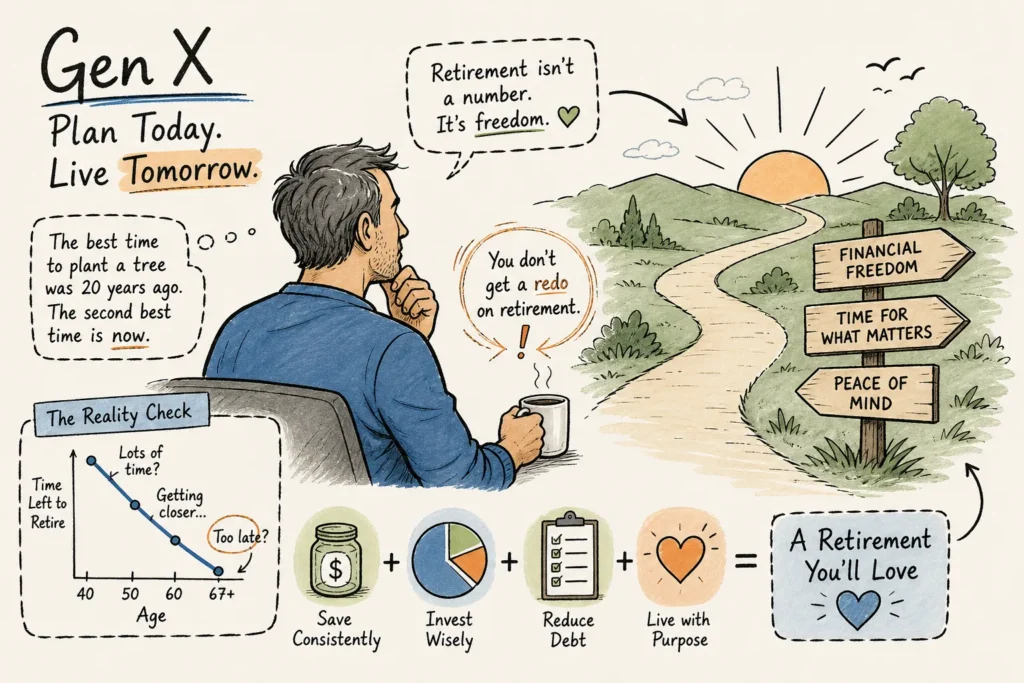
This generation is also being squeezed from both ends. Private hospital bills for ageing parents can run into tens of thousands of ringgit annually. A four-year private university education in Malaysia often exceeds RM120,000. Meanwhile, the clock on a working career is ticking down with 10 to 20 years remaining. Unlike their parents’ generation, Gen X entered the workforce without defined-benefit pension promises, and this cohort is now racing against time to build a retirement that will last 25 years or more.
This guide is not about panic. It is a clear, sequenced framework developed through the work we do at CF Lieu, an independent flat-fee wealth advisory practice, to help Gen X professionals close retirement financial gaps while they still have enough runway to do it meaningfully. Here is where to start.
Table of Contents
The sandwich generation squeeze that makes retirement planning for Gen X harder
Over recent decades, employer-funded defined-benefit pension promises declined, increasing reliance on EPF and individual savings. The retirement safety net their parents enjoyed, largely funded by employers, was quietly disappearing at the same time that members of Generation X were just beginning their careers. That structural shift means the burden of retirement funding has fallen almost entirely on the individual, even as financial obligations outside retirement have multiplied.
The numbers make this concrete. Private hospital bills for an ageing parent requiring chronic care or surgical intervention can reach RM12,000 to RM40,000 in a single year, with complex cases or extended stays pushing costs toward the higher end of that range. A child’s four-year private degree programme in Malaysia regularly exceeds RM120,000 in total fees. These are not hypothetical numbers; they are costs that Gen X households are actively managing right now, often at the peak of their earning years and simultaneously at the peak of their competing financial demands.
The EPF data confirms how little headroom most members have. The median balance for Malaysians aged 45 to 49 is RM38,678, while the average sits at RM114,808. The gap between mean and median tells its own story: savings are distributed very unevenly, and the median is the truer picture of where most members actually stand. At RM5,000 per month for a couple, even RM114,808 in EPF savings funds fewer than 23 months of retirement. Any credible late-career retirement strategy must begin by acknowledging this reality clearly.
What your retirement gap actually looks like in numbers
Healthcare alone adds RM800 to RM2,000 per month once private medical cover for retirees aged 60 and above is factored in. Apply a conservative 2 to 3% annual inflation rate over a 20 to 25-year retirement horizon to the RM4,500 to RM6,000 monthly baseline, and the total capital required for a typical Klang Valley couple approaches RM1.5 to RM2 million, derived from projecting inflation-adjusted withdrawals over 25 years at a sustainable drawdown rate. That figure is not a scare tactic; it is simply the starting coordinate. You cannot close a gap you have not measured.
The income replacement equation works like this: estimate your annual retirement spending in today’s money, project it forward to your retirement age using inflation, then calculate the lump sum needed to sustain withdrawals for 20 to 25 years. From that target number, subtract what EPF, PRS, and private investments are projected to deliver. The remainder is your retirement gap, and for most Gen X professionals in Malaysia, it is larger than expected because many are relying almost entirely on EPF while their other savings are either modest or uncoordinated. Generic rules of thumb rarely survive contact with actual numbers. A personalised projection does.
Running this calculation properly requires more than a back-of-envelope estimate.
EquaWealth, the retirement modelling platform built by CF Lieu, runs this calculation interactively:
You input your actual EPF balance, contribution rate, expected retirement age, and monthly spending target, and the platform projects whether your current trajectory closes the gap or falls short under conservative, moderate, and adverse conditions. A retirement gap calculator of this kind surfaces the precise shortfall figure that generic online tools cannot replicate.
This is how retirement plan modelling works
Maximising EPF and PRS for Gen X retirement planning
i-Simpan versus KWSP 17A: which top-up route suits you
For salaried employees, the most accessible catch-up tool is voluntary EPF contribution through i-Simpan, which allows members to top up beyond the mandatory payroll deduction. Alternatively, employees can request a higher contribution rate through their employer via the KWSP 17A route. Under the current EPF three-account structure, new contributions are split 75% to Account 1 (Akaun Persaraan), 15% to Account 2, and 10% to Account 3 (Akaun Fleksibel). Every additional voluntary ringgit directed into EPF largely compounds in Account 1, which is the highest-priority retirement account.
Account 3 deserves a specific caution. While the flexible withdrawal feature addresses short-term cashflow needs, tapping Account 3 repeatedly reduces the balance compounding over your remaining working years. A member who withdraws RM5,000 annually from Account 3 over a 15-year horizon forgoes not just that capital but also its compounding at EPF’s historical dividend rate, a cost that runs into the tens of thousands by retirement age. Treat Account 3 as a financial safety valve, not a secondary spending account.
How to choose PRS funds and use the five-year tax relief window
The PRS tax relief offers a parallel opportunity that too many in this cohort underuse. For YA2026 through YA2030, a five-year window, contributions to Securities Commission-approved PRS funds, combined with deferred annuity premiums, qualify for personal income tax relief of up to RM3,000 per year of assessment. For a Gen X professional in the 24 to 26% tax bracket, that translates to RM720 to RM780 in annual tax savings, on top of the investment returns within the PRS fund itself. This relief is separate from the EPF and life insurance relief ceiling, making it a genuinely additive tax-efficient vehicle.
The window from 2026 to 2030 is finite. Acting this year rather than next year costs nothing extra, but every year of delay forfeits compounding on those contributions. When selecting PRS funds, match the fund’s risk profile to your retirement timeline: growth-oriented funds for those 15 or more years from retirement, and progressively more defensive allocations as that horizon shortens.
Building a portfolio that still grows with a decade on the clock
Many Gen X investors in Malaysia have quietly drifted toward ultra-conservative holdings: fixed deposits, capital-guaranteed products, and money market funds. The instinct feels prudent after watching market cycles, but at 2 to 3% annual inflation, a purely capital-preserving portfolio loses purchasing power over a 15-year retirement runway. The bigger risk for a 48-year-old is not a short-term market correction; it is arriving at retirement with a portfolio that cannot keep pace with rising costs for 25 years.
Sequence-of-return risk, the danger of a market downturn early in retirement depleting a portfolio before it can recover, is a retirement-phase concern. For someone 15 years from retirement, moving heavily into bonds or fixed deposits prematurely sacrifices growth without actually solving the sequence-of-return problem. Staying growth-oriented now and de-risking gradually as retirement approaches is the more defensible approach, supported by long-run asset allocation research.
A practical allocation for Gen X investors 15 to 20 years from retirement is roughly 60 to 70% equities and 30 to 40% lower-risk assets such as bonds, sukuk, and EPF. Within the equity allocation, genuine diversification matters: many Malaysian investors hold multiple unit trust funds that are essentially the same underlying equity exposure, creating an illusion of diversification without the actual risk-reduction benefit. Regional equities, REITs, and bond funds serve as meaningful diversifiers alongside local holdings. The precise allocation should be calibrated to your risk tolerance, retirement gap, and income target, which is exactly why a personalised portfolio review adds more value than any generic model.
Stress-testing your retirement income before you actually retire
A static retirement calculation assumes smooth compounding and predictable withdrawals. A stress test models what happens when things do not go to plan: a market correction in the first three years of retirement, a medical emergency at 72, or a spouse who lives to 93. These are not unlikely events; they are normal features of a 25-year retirement that static calculations simply ignore.
The concept of a sustainable withdrawal rate sits at the centre of this analysis. Drawing down a portfolio too quickly in early retirement permanently impairs the capital base, even if markets eventually recover.
Our own EquaWealth’s retirement modelling platform runs precisely these interactive stress scenarios, showing projected retirement income under conservative, moderate, and adverse market conditions, connected to a household’s actual balances across EPF, investments, property, and insurance rather than hypothetical averages. The difference between a plan that holds under adverse conditions and one that quietly fails at year 12 is often not the investment return; it is the withdrawal strategy and the spending assumptions.
Many Gen X professionals in Malaysia have received financial advice from insurance agents, unit trust consultants, or bank relationship managers, all operating under commission-based models where the product recommendation is shaped by what the adviser earns. CF Lieu operates on a flat-fee, commission-free basis.

That distinction matters because the retirement modelling, portfolio review, and income replacement planning are structured entirely around the client’s outcome. For a Gen X professional holding a complex mix of EPF, unit trusts, property equity, and life insurance, a structured second-opinion review with a licensed CFP surfaces blind spots that cost far more than the advisory fee if they remain unaddressed for the next 15 years.
3 moves Gen X should prioritize now
The first and highest-impact action is to raise your savings rate before your next salary review. Target a minimum of 20 to 25% of gross income directed toward retirement; statutory EPF contributions count, but most salaried Malaysians need voluntary top-ups via i-Simpan or higher payroll contributions to reach that level. This higher target reflects the catch-up required when starting later; those who began saving consistently at 30 can sustain a lower rate, while late starters need closer to 25 to 30%. The practical trigger is straightforward: redirect the next pay increment entirely to retirement savings before lifestyle spending expands to absorb it.
The second move is to eliminate high-interest debt. Personal loans and credit card balances compound against you at 12 to 18% annually while EPF historically earns in the mid-single-digit range. Paying off these balances first is a guaranteed return on capital that no investment can reliably match. Once cleared, redirect those monthly repayment amounts directly into voluntary EPF contributions or PRS. The catch-up retirement contributions that the remaining runway demands require freed-up cashflow, and debt repayment is the fastest way to create it.
The third move is to maximise PRS contributions now and book a retirement gap assessment. With the PRS tax relief confirmed through YA2030, there is a five-year runway to claim RM3,000 annually in relief while building a supplementary retirement fund outside EPF. Alongside this, model your actual retirement gap rather than estimating it.
CF Lieu offers a free initial assessment where we run a structured projection of whether your current EPF contributions, voluntary savings, and investments will realistically replace your income in retirement. EquaWealth’s modelling tools are available for an interactive first look at the numbers before that conversation. The cost of not knowing is too high to postpone the calculation any further.
The runway is shorter than it feels, but it is not gone
Retirement planning for Generation X in Malaysia is not a lost cause. The EPF median balance data is sobering, but it is a starting point for action, not a verdict. Closing the retirement gap is entirely achievable when you combine a higher savings rate, tax-efficient vehicles like EPF voluntary contributions and PRS, a portfolio that remains growth-oriented for the right number of years, and stress-tested income projections that model the retirement you will actually live rather than an idealised average.
The greatest risk facing Gen X professionals right now is not market volatility. It is the quiet confidence of assuming the current plan is sufficient without ever modelling the numbers against realistic retirement costs, inflation, healthcare, and longevity. That assumption, left unchallenged, is the most expensive financial decision most people never realise they made.
If you want to see exactly where you stand, start with EquaWealth’s retirement modelling tools or book a flat-fee, no-product-push assessment with CF Lieu.
More Retirement Planning Case Studies 👇
✅ Retirement Planning for Single Income Households
✅ Retirement Planning for Dual Income Households
✅ Retirement Planning for Business Owners
✅ Retirement Planning for Medical Professionals
✅ Retirement Planning for Malaysians Working in Singapore
✅ Retirement Planning for Malaysians Working in the Middle East
✅ Retirement Planning for Malaysians Working in the US & Europe