
Most retirement advice starts from the same assumption: save more, invest consistently, and stop working one day with enough money to last. That works reasonably well for average earners. For high-income professionals, it is dangerously incomplete, particularly when it comes to the question of how a high-income professional should approach retirement planning differently from an average earner.
A director earning RM30,000 a month cannot follow the same retirement blueprint as someone earning RM5,000. The numbers are different, the tax exposure is different, and the lifestyle at stake is fundamentally different. High earners are not simply trying to accumulate enough to survive retirement. They are trying to preserve a level of income complexity that generic financial planning was never designed to address. Many high-income clients raise exactly this issue with CF Lieu’s advisory practice, and the answer always begins with understanding why your income level changes everything about how you plan.
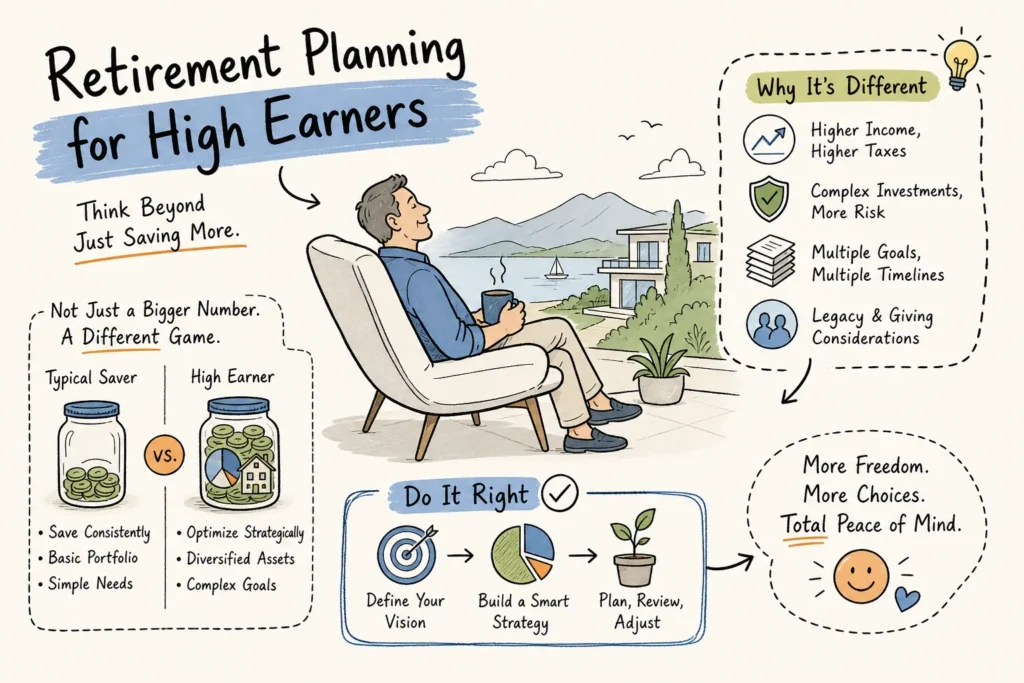
This article covers four dimensions where high earners must think differently: lifestyle income replacement, tax vehicle limitations, income concentration risk, and portfolio construction for a 30, 40-year retirement runway.
Table of Contents
How Should a High-Income Professional Approach Retirement Planning Differently from an Average Earner?
The short answer is: across every dimension. The savings targets are larger, the tax vehicles reach their limits faster, the income concentration risk is greater, and the portfolio must sustain withdrawals over a far longer and more expensive horizon. The sections below address each of these in turn.
The Lifestyle Replacement Gap That High Earners Routinely Underestimate
The 70% income replacement guideline was designed with average earners in mind. At that income level, the rule holds reasonably well. Fixed expenses drop when the mortgage is paid, children are financially independent, and commuting costs disappear. High earners carry a different cost structure: premium healthcare, travel, club memberships, multi-property ownership, and lifestyle commitments that do not automatically shrink the moment you stop working. The real savings target for high-income professionals is closer to 60, 66% of post-tax income annually, not the standard contribution amounts most planners discuss.
The lump-sum calculation makes the gap even starker. Using the 4% withdrawal rule, your retirement target equals 25 times your desired annual retirement income. If you need RM200,000 per year in retirement, that is a RM5 million target before inflation adjustments. Add 20 years of 2% annual inflation, and that figure multiplies by approximately 1.49, pushing the real target toward RM7.45 million. That number is not designed to alarm you. It is designed to give you something concrete to plan against.
Contrast that with EPF’s revised basic savings benchmark of RM390,000 at age 55, which delivers roughly RM800 to RM1,300 per month over 25 years. For a high-income professional, that is not a retirement plan, it is a supplement at best. EPF data as of late 2024 indicated that only around 36% of active members met the earlier RM240,000 basic savings benchmark; the proportion meeting the revised RM390,000 threshold is likely lower still. Malaysia Department of Statistics data also highlights structural gaps in household incomes that make average replacement ratios misleading for high earners. The structural gap is not a matter of discipline. It is a matter of planning specifically for your income level.
When Standard Retirement Vehicles Hit Their Ceiling
EPF and the Private Retirement Scheme (PRS) are valuable tools, but they reach their tax-efficiency ceiling quickly for high earners. The combined EPF and PRS tax relief available in 2026 stands at RM10,000: up to RM7,000 for EPF contributions (combined with life insurance premiums) and a separate RM3,000 for PRS and deferred annuities.
That does not mean you stop using them. EPF voluntary self-contributions allow deposits of up to RM100,000 per year beyond mandatory contributions, though it is worth noting that tax relief for EPF contributions is subject to the RM7,000 combined cap; consult the latest LHDN guidance for the precise treatment of voluntary self-contributions. The scheme offers capital-guaranteed growth with a minimum 2.5% annual dividend, as stipulated under the EPF Act. For large sums, this remains a useful capital preservation layer. PRS contributions beyond the RM3,000 deductible ceiling still grow tax-free within the scheme, making it worth continuing past the point of additional relief. The principle is to extract full value from existing structures before looking further, without mistaking that step for a complete retirement strategy.
Beyond EPF and PRS, high earners typically need exposure across funds, dividend-generating equities, real assets, and private credit funds. These are not optional extras. They are the primary accumulation engines for anyone whose income far outpaces what registered retirement schemes were built to service. For high-income professionals in Malaysia, direct REIT holdings in personal accounts can carry significant tax drag at marginal rates of up to 30%, making indirect exposure through unit trust structures a more tax-efficient route for real estate income. Private credit funds offer non-correlated income streams with fixed yields that sit outside public market volatility, providing stability that neither EPF nor PRS can replicate.
The Single Income Stream Trap and Why It Amplifies Retirement Risk
Senior executives and high-income professionals often rely on one primary income source: their employment. When that income stops, whether by choice, redundancy, or health, there is no fallback while the portfolio transitions into income-generating mode. Average earners face the same structural risk, but with lower stakes. High earners face it while maintaining an expensive lifestyle and a large portfolio that is suddenly exposed to market movements without fresh capital being added.
Sequence-of-returns risk is the specific mechanism that turns a bad market into a permanent problem. A 20% drawdown in the first two years of retirement on a RM5 million portfolio removes RM1 million before any recovery begins. If withdrawals continue during that drawdown, you are selling assets at depressed prices and shrinking the capital base needed to compound future gains. Established retirement income research, including the foundational sequence-of-returns analysis developed in the early work of William Bengen, indicates that early losses are responsible for the majority of retirement plan failures: not because the portfolio was too small, but because withdrawals locked in those losses before the market recovered. The larger the portfolio and the higher the withdrawal amount, the more damaging this sequence becomes. For a practical primer on how sequence-of-returns risk works and mitigation tactics, see this sequence-of-returns risk guide.
The practical response is building a meaningful liquidity buffer before retirement arrives. Within five years of your intended retirement date, target holding approximately four years of net expenses, meaning total annual expenses minus any guaranteed income sources, in liquid, low-risk vehicles such as high-yield savings accounts, money market funds, or short-duration fixed deposits. At a minimum, high-income professionals whose specialised roles would take significantly longer than average to replace should hold 12 to 24 months of essential expenses in immediately accessible cash before any portfolio drawdown begins.
Portfolio Construction for a 30, 40-Year Retirement Runway
Approaching retirement with an equity-heavy accumulation portfolio is appropriate during your earning years. It is not appropriate in the five years before and after you stop working. As retirement approaches, the standard professional approach is to shift toward a 50/50 or 60/40 equity-to-fixed-income allocation. This is not about becoming conservative, it is about protecting the early withdrawal years from a damaging return sequence while allowing the equity portion time to recover without being liquidated under pressure.
The three-bucket income strategy provides the operational framework for managing this transition:
Bucket One: Immediate liquidity (years one to two)
Hold one to two years of expenses in cash or equivalents. This covers near-term withdrawals without touching growth assets.
Bucket Two: Replenishment (years three to seven)
Moderate-risk assets that generate income and can be drawn down to refill the cash bucket as it depletes.
Bucket Three: Long-term growth (ten-plus years)
Equities and alternatives where market volatility is tolerable because withdrawals from this bucket are not imminent. This structure eliminates the need to sell growth assets during downturns, the core driver of sequence-of-returns risk.
For high earners, this allocation also needs to incorporate non-correlated income sources. Private credit funds, REITs held through tax-efficient structures, infrastructure, and income-focused equities all contribute steady cash flows that do not move in tandem with public equity markets. When your annual withdrawal amount is large and your fixed lifestyle costs are high, the portfolio cannot afford to depend entirely on public market performance in any given year.
High earner retirement: tax-efficient strategies worth stacking
Most high earners claim the obvious tax reliefs but leave the more powerful options untouched. Voluntary EPF contributions, PRS allocations, and private insurance with investment components each carry their own incremental tax benefits. Stacking these systematically over a 10 to 20 year accumulation phase, rather than approaching them as annual ad hoc decisions, compounds meaningfully. At a marginal tax rate of 26% to 30%, the band applicable to higher personal income in Malaysia, the RM3,000 PRS relief alone generates an immediate tax saving of between RM780 and RM900 before any investment growth is counted. (The precise figure depends on your assessed marginal rate; consult the current LHDN tax schedule to confirm the applicable band.)
Defined benefit-style structures for business owners
For self-employed professionals and business owners, the opportunity set extends further. Defined benefit-style structures, similar in principle to cash balance plans used in other jurisdictions, allow contribution levels that far exceed standard thresholds. A cash balance plan works by crediting a notional account annually based on a fixed percentage of salary and a guaranteed interest rate, entirely separate from market performance. For business owners in their fifties seeking to accelerate retirement savings significantly, these structures can shift the trajectory of a retirement plan in ways that voluntary EPF contributions simply cannot match.
Insurance coverage that actually matches your lifestyle exposure
A significant proportion of high-income professionals have insurance policies they set up early in their careers and have not revisited since. A life policy taken out on a RM5,000 monthly salary provides wholly inadequate coverage on a RM20,000 monthly salary. The gap between insured income and actual income is one of the most overlooked retirement risks at this income level, particularly for disability and critical illness coverage, where the financial consequences of an event can permanently derail a retirement plan.
Financial planners working with high-income clients in Malaysia broadly recommend life cover of 10 to 15 times annual income for those with dependants, though actual cover should always be personalised to individual circumstances. For someone earning RM240,000 per year, that translates to indicative coverage of between RM2.4 million and RM3.6 million. Critical illness cover, ideally in the range of RM200,000 to RM500,000, provides a capital buffer that prevents retirement savings from being liquidated to fund medical costs during the most financially vulnerable years. Disability income insurance is arguably the most critical component for high earners, because their human capital, not their accumulated savings, remains their largest asset through most of their working lives.
Insurance is not a standalone product purchase. It is a risk management layer that protects the retirement plan itself. An adequate insurance structure means a serious health event does not force an early drawdown of investment assets at the worst possible time, preserving both the plan’s longevity and the retiree’s quality of life without compromise.
Withdrawal strategies that protect retirement income for 30 to 40 years
The order in which you draw from different accounts across a 30-year retirement determines how much tax you pay in total, how long your portfolio lasts, and whether your income sustains the lifestyle you planned for. Drawing from taxable accounts first, then tax-deferred vehicles, and reserving tax-free assets for later years is a well-established sequencing principle supported by considerable practitioner research. Applied correctly over a multi-decade retirement, it can extend portfolio longevity by years and meaningfully reduce total tax paid.
The period between leaving full-time employment and the point at which mandatory EPF withdrawals or other statutory distributions begin is a strategic window that most retirees ignore. Income during this gap is lower, which compresses the effective tax bracket. This is the ideal window to reposition assets, execute partial conversions, or restructure holdings at lower cost. High earners who plan this gap period deliberately avoid the tax spike that catches many by surprise when multiple income streams activate simultaneously.
A sustainable retirement withdrawal rate for a 30 to 40 year retirement is lower than most high earners intuitively assume. Factoring in inflation, healthcare cost escalation in private facilities, and the possibility of supporting family members well into retirement, the cashflow stress-test is non-negotiable before any retirement date is confirmed. Modeling withdrawals against realistic longevity assumptions, rather than optimistic ones, is what separates a plan that holds from one that fails in the late stages of retirement, when the ability to course-correct is most limited.
Why Bespoke Retirement Roadmapping Beats Generic Financial Advice
Generic retirement plans are built for the average client: one income source, standard EPF and PRS contributions, a straightforward expense profile. They do not account for multiple asset classes held across different platforms, business interests, complex tax positions, concentrated shareholdings, or the need to stress-test a 30, 40-year income runway with inflation adjustments and healthcare cost projections. If your financial situation is above average in complexity, your retirement plan needs to match that complexity, or it will fail you precisely when it matters most.
CF Lieu’s advisory practice offers a Retirement Roadmapping & Scenario Analysis advisory service, assisted by AI, specifically catered for high-income professionals who need more than a spreadsheet and a standard plan. The engagement covers a personalised cashflow stress-test across multiple scenarios and a tax efficiency review across EPF, PRS, and supplementary investment vehicles. It also includes asset consolidation and allocation restructuring, together with a sustainability analysis that models income replacement across a 30, 40-year horizon. Because CF Lieu operates on a flat-fee, commission-free model, the guidance is structured to align entirely with your outcome rather than any product provider’s revenue, there are no commissions, and no incentive to recommend whatever earns the highest margin.
The Retirement Plan Your Income Level Deserves
Retirement planning for high-income professionals is structurally different from the generic advice designed for average earners, and understanding how a high-income professional should approach retirement planning differently from an average earner is the first step toward getting it right. The savings targets are larger, the tax vehicles reach their limits sooner, and the income diversification required is far more complex.
The key actions are concrete. Calculate your actual lump-sum target using 25 times your desired annual retirement income, then inflation-adjust it for your accumulation horizon. Maximise EPF voluntary contributions and PRS before building your supplementary portfolio across unit trusts, private credit, and income-focused equities. Build a four-year liquidity buffer within five years of retirement. Restructure your allocation to protect against sequence-of-returns risk. Diversify your income sources before you need them, not after the single income stream stops.
The right retirement plan for a high-income professional does not come off the shelf. It is built specifically around your income level, your lifestyle commitments, and the 30, 40-year financial trajectory you are working to protect.
➡️ 10 Questions to assess your Financial Readiness Test for Retirement / Career Break:
➡️ Want a licensed advisor to independently plan, validate, and optimize your early retirement numbers without the sales talk?
Here to schedule an assessment call
▶️ Or want to run the numbers yourself without talking to anyone?
Tap Here to quickly use our web app to build and stress-test your retirement roadmap in the next 5 min
Related: Retirement Planning Checklist for Managers and Directors
FAQs: Retirement Planning for High Earners
How should retirement planning for a high-income professional differ from an average earner?
For high earners the approach must change across every dimension: savings targets are larger, tax-advantaged vehicles reach their ceilings sooner, income concentration risk is greater, and portfolios must sustain withdrawals over a much longer and more expensive horizon. Generic blueprints designed for average earners therefore leave important gaps for high-income professionals.
What retirement income replacement ratio should high earners target?
High-income professionals typically need a higher replacement ratio than the standard 70% guideline—closer to 60–66% of post-tax income annually when you account for the cost of a premium lifestyle. That higher percentage reflects non-discretionary lifestyle costs like premium healthcare, travel, club memberships and multi-property ownership that don’t automatically shrink in retirement.
How do I calculate a lump-sum retirement target using the 4% withdrawal rule?
Multiply your desired annual retirement income by 25 to get a rough lump-sum target (the 4% rule). For example, RM200,000 per year implies about RM5 million; applying 20 years of 2% inflation (≈1.49 multiplier) pushes that target toward approximately RM7.45 million.
Why are EPF and the Private Retirement Scheme (PRS) often insufficient for high earners?
EPF and PRS are useful but hit a tax-efficiency ceiling quickly for high earners: combined EPF and PRS tax relief in 2026 is limited to RM10,000 (up to RM7,000 for EPF combined with life insurance and a separate RM3,000 for PRS and deferred annuities). In addition, EPF’s revised basic savings benchmark of RM390,000 at age 55 provides only a modest monthly supplement and is far short of the lump sums many high earners need.
What is income concentration risk and how does it affect retirement planning for high earners?
Income concentration risk is the danger that a large share of your earnings comes from a single source (employer, business, equity holdings) and could fall suddenly. High earners need to plan for that by diversifying income sources, protecting downside with insurance or liquidity buffers, and structuring wealth to reduce reliance on one payor or asset.
How should portfolio construction change for a 30–40 year retirement runway?
Portfolios for a multi-decade retirement need to balance growth to outrun inflation with controls for sequence-of-returns risk and sustainable withdrawals. That typically means a higher allocation to growth assets early, regular rebalancing, inflation protection, and a withdrawal strategy designed to preserve capital over a longer, more expensive horizon.
What practical steps can high earners take now to close the retirement gap?
Set a concrete, higher lump-sum target based on your desired post-tax income; maximize available tax-efficient vehicles while recognizing their limits; diversify income and investments; consider deferred annuities or private structures; and work with an adviser (the article cites clients of CF Lieu) to tailor planning to your income level. These actions move planning from vague goals to a specific, actionable roadmap.
How much retirement savings do I need if I earn RM30,000 a month?
Replacing 80% of a RM30,000 monthly salary requires RM24,000 per month or RM288,000 per year. At a conservative 4% withdrawal rate, that implies a target portfolio of roughly RM7.2 million to sustainably generate that income.
What is the ‘single-vehicle trap’ and why is it dangerous?
The single-vehicle trap is relying heavily on one wealth source—such as a large EPF balance, a leveraged property portfolio, or concentrated company shares—for retirement. That concentration introduces fragility because market downturns, property stagnation, or share losses can occur when you need funds most, and sequence-of-returns risk can permanently impair outcomes.
How should high earners think about insurance and healthcare in retirement planning?
High earners often face rising private medical costs and other ongoing commitments that don’t disappear in retirement, so insurance coverage needs to keep pace with income growth. The article advises reassessing protection levels and factoring higher healthcare, travel, and family-support costs into retirement income planning rather than assuming expenses will decline.
What can someone do if they start saving for retirement late?
The maths become more demanding but remain fixable with the right structure and enough runway: increase voluntary savings, diversify beyond statutory schemes, strengthen private vehicles, and review withdrawal sequencing and insurance. Late starters will likely need higher savings rates and more deliberate asset allocation to mitigate sequence-of-returns and concentration risks.