
This retirement planning checklist for senior managers and directors addresses the complex financial issues that Malaysia’s highest-earning professionals consistently underestimate. Their financial lives are not simpler than those of other workers. They are considerably more complex. EPF balances that may exceed RM1 million, executive share options with LHDN implications, employer-sponsored healthcare that disappears on the last working day, directorial duties that outlast the resignation letter, and a lifestyle calibrated to decades of senior-level income, none of this fits neatly into a generic retirement guide.
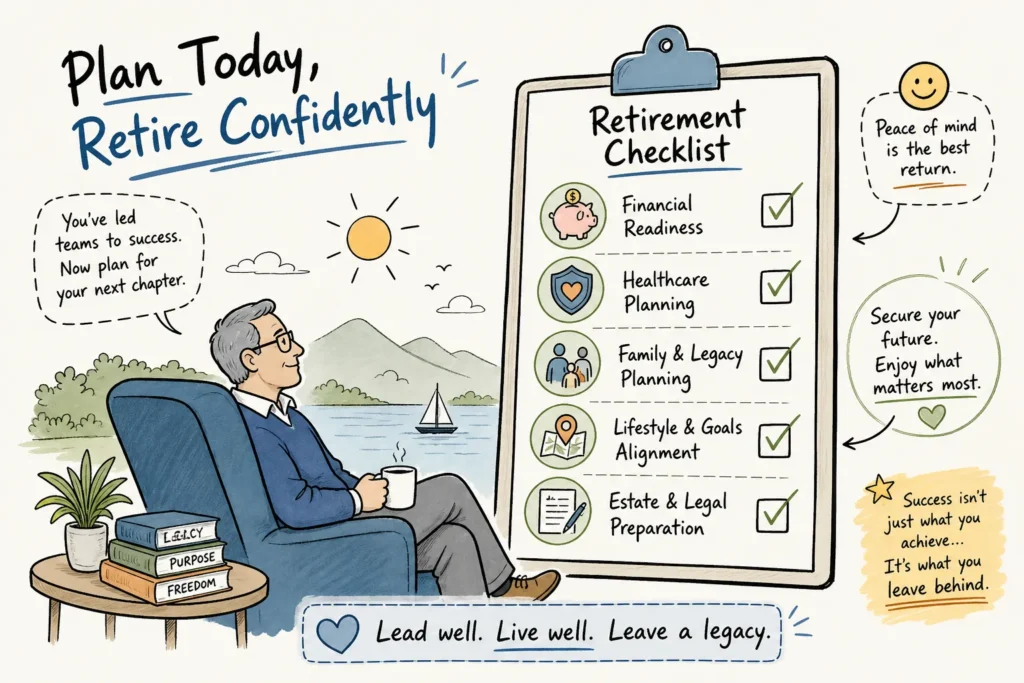
At CF Lieu Advisory, this pattern surfaces regularly. Senior executives arrive with impressive career histories and, in many cases, significant gaps in their retirement readiness. The checklist below addresses the five planning areas that matter most for directors and senior managers in Malaysia, and explains why having a Certified Financial Planner (CFP) review it afterwards transforms a checklist into an actual plan.
Table of Contents
1. Conduct a full portfolio audit, not just an EPF balance check
Mapping every asset across your financial life
Most senior managers know their EPF balance and perhaps their unit trust holdings. What they rarely have is a single, consolidated picture of all their assets in one place. A proper pre-retirement checklist for directors covers EPF Accounts 1, 2, and Akaun Sejahtera; private investment accounts; fixed deposits; property holdings; business interests; and any deferred compensation arrangements such as long-service awards or executive share options. Each of these carries a different liquidity profile, tax treatment, and risk exposure that must be understood before any retirement income planning can begin.
Deferred compensation retirement planning and share-based plans in particular require legal and tax review before retirement. Under Malaysia’s Income Tax Act 1967, lump-sum deferred pay is generally taxed in the year of receipt upon cessation of employment, and the nature of the payment determines whether any exemption applies. Consulting a qualified tax adviser and reviewing LHDN public rulings on share options is not optional at this level; it is essential. In 2026, EPF members with balances exceeding RM1.1 million have new partial withdrawal flexibility before age 55, with the threshold rising to RM1.2 million in 2027 and RM1.3 million in 2028. The goal of the audit is not just a net worth number; it is understanding which assets can be drawn on, in what order, and at what cost.
Stress-testing your portfolio for sequencing risk
A consolidated asset map tells you what you have today. The more critical question is whether it holds up over a 25, 30-year retirement. Sequence-of-return risk is a genuine threat for executives who retire with a large lump sum and no guaranteed income floor: a market downturn in the first two to three years of retirement can permanently erode capital in a way that a mid-career correction never would. Research from long-running withdrawal-rate studies, including work by financial planning academics on sustainable drawdown rates, supports running a cashflow stress-test that models multiple scenarios against different return environments, giving you a defensible answer rather than an optimistic assumption. For senior executives with complex retirement portfolios, this analysis is best conducted by an adviser operating under a flat-fee structure, where the recommendation is not influenced by product commissions.
2. Calculate your income replacement number honestly
The 65, 75% replacement ratio in ringgit terms
General retirement guidance suggests replacing two-thirds of pre-retirement income. For senior executives, the appropriate range, supported by financial planning industry guidance, sits at 65, 75% of gross annual income, because retirement spending at this level still includes private healthcare premiums, international travel, children’s education costs, and a lifestyle that does not simply reset to a lower gear. At RM300,000 per year in current income, that translates to a minimum annual retirement need of RM195,000 to RM225,000. EPF’s own Retirement Income Adequacy framework, with tiers of RM390,000 (Basic), RM650,000 (Adequate), and RM1.3 million (Enhanced), was calibrated for the general Malaysian workforce, not for a director earning RM25,000 to RM40,000 per month. The EPF minimum benchmark of RM240,000 by age 55 is similarly a general-workforce figure, not a retirement readiness standard for senior managers.
Applying the 4% rule to set a realistic corpus target
Multiply the annual income need by 25 to arrive at the retirement corpus required under the 4% sustainable withdrawal framework. For a director earning RM300,000 per year who targets full income replacement, the corpus required is approximately RM7.5 million before adjusting for inflation. At a 2% annual inflation rate over 20 years, the real target climbs to approximately RM11 million. More conservative withdrawal rates of 3.3%, 3.7% would push the requirement higher still. Senior managers in Malaysia should realistically target a retirement corpus for senior executives of RM3 million to RM8 million, depending on income level, lifestyle expectations, and planned retirement age. If that figure feels distant, the time to close the gap is during the highest-income years immediately before retirement.
3. Run an insurance gap analysis before you clear your desk
The coverage cliff most executives don’t see coming
On the day an executive retires, employer-sponsored group medical, hospitalisation, and life insurance typically end. This coverage cliff arrives with no grace period. For a 58-year-old director with a pre-existing condition, purchasing a new individual medical card at that point is both expensive and uncertain: Malaysia’s private health insurance market is risk-rated, premiums rise sharply with age, and underwriters can exclude pre-existing conditions entirely. Comprehensive executive-level individual medical coverage for someone aged 60 to 65 costs between RM6,000 and RM18,000 per year, with premiums from providers such as AIA and Prudential reaching the higher end for plans with annual limits above RM400,000 and guaranteed renewal. These figures are indicative of current market pricing and should be verified directly with insurers or an independent adviser, as premiums vary by health status and plan terms.
Malaysia does not yet have a mature long-term care insurance market. Critical illness plans and takaful products with savings components can partially fill that gap. Until broader coverage options are in place, executives who wait until their final working month to address this find their options considerably narrower and more expensive.
What to do at least 3 years before you retire
The safest strategy is to purchase a portable individual medical card while still employed and in good health, ideally at least three years before the planned retirement date. This locks in coverage before the employer plan ends and before age-related loading makes premiums prohibitive. The checklist item here is specific: review current group coverage terms, identify the gap between that coverage and your post-retirement needs, compare individual plan options with guaranteed renewal, and calculate the annual premium cost as part of your retirement income budget. An independent adviser who has no sales target from insurance sales is well-placed to run this analysis, as the recommendation is grounded in your needs rather than product incentives, though you should always request a clear disclosure of how any adviser is remunerated before proceeding.
4. Address estate planning and director exit obligations
The legal documents every director should have in place
Estate planning is consistently the last item senior managers get to, and frequently the one they skip. The executive retirement checklist for directors should include, at minimum: a valid and updated will executed under the Wills Act 1959 (or a Wasiat for Muslim directors); beneficiary nominations for EPF (which operate under a separate legal framework from a will bequest and govern EPF distribution directly); beneficiary nominations for all insurance policies; and a Power of Attorney covering financial and healthcare decisions should the director become incapacitated. EPF nominations and will bequests are governed by different legal instruments in Malaysia; both need reviewing, and a mismatch between them creates exactly the kind of dispute that delays distribution for years.
Directors who hold shares in private companies need to address what happens to those shares within the estate plan. A trust structure may be worth considering for high-net-worth estates: it simplifies distribution, protects assets from probate delays, and can be structured to provide controlled income to beneficiaries rather than a single lump-sum transfer.
The succession handover checklist and residual director duties
Directors do not simply walk out on their last day. Fiduciary duties of care, loyalty, and good faith remain in force until the board formally accepts the resignation. The exit checklist should cover: formal board resignation with documented acceptance; return of company documents and access credentials; completion of the handover document covering client relationship maps, strategic plans, and standard operating procedures (SOPs); and a legal review of any non-compete clause for scope and duration. Succession planning ideally begins three to five years before the retirement date, not three months before. For executives with complex exit obligations, that runway is a necessity, not a luxury.
5. Retirement planning checklist for senior managers and directors, Set a retirement date target and work backwards
Why the date matters more than you think
Without a specific retirement date, every financial decision remains abstract. The date anchors the entire executive exit planning process. It determines how long the portfolio has to grow, when EPF can be accessed, when insurance must be ported, how much time remains to close any corpus shortfall, and when the succession handover process needs to begin. Senior managers should set a target date and then model two additional scenarios: retiring two years earlier and retiring two years later. Understanding the financial difference between those three scenarios often clarifies priorities more effectively than any amount of general planning advice.
Building the 3-to-5-year retirement runway
For directors with complex exit obligations, a three-to-five-year runway before retirement is not a preference; it is a structural requirement. The runway covers topping up retirement savings in the highest-income years, restructuring the portfolio toward a more conservative drawdown posture, porting insurance, completing estate planning documents, and beginning the formal succession handover process. EPF’s 2026 rules allow full withdrawal at age 55, with new partial withdrawal flexibility for members with balances above RM1.1 million before that age; see the EPF update 2026 for more detail. It is worth noting that EPF lump-sum withdrawals at age 55 are generally not subject to personal income tax under current LHDN rules. However, other employment-related lump sums received upon retirement, such as gratuities or contractual deferred compensation, may be taxable depending on their nature and applicable exemptions; these should be modelled separately with a qualified tax adviser as part of your overall retirement transition plan.
6. Have a CFP review your completed checklist for blind spots
What a checklist alone cannot catch
A checklist is a starting point, not a plan. It tells you which questions to ask; it does not tell you whether your answers are right, whether your assumptions are realistic, or whether you have missed a structural issue in your financial architecture. Senior executives with multiple asset classes, deferred compensation, director obligations, and a 30-year retirement runway have complex interdependencies that require a trained professional to evaluate. A missed insurance gap, an incorrectly nominated EPF beneficiary, or an underestimated corpus shortfall can each cost far more than a professional review ever would.
Why an independent, flat-fee CFP review matters at this stage
CF Lieu, Wealth Advisor, Financial Advisor, and Financial Planner offers independent, flat-fee retirement planning reviews specifically designed for professionals and executives who want a second opinion free from product-driven conflicts of interest. Operating under a flat-fee model means the advisory relationship is structured around the client’s retirement income goals, there is no commission arrangement tied to any particular fund or insurance product. The process begins with a free initial consultation where the completed checklist is reviewed, blind spots are identified, and a personalised retirement roadmap is outlined. For senior managers and directors who have spent 20 to 30 years building wealth, this is the step that ensures nothing material is left to chance.
7. Your next step after completing the checklist
Senior managers and directors face a more complex version of the retirement planning challenge than most people. The five checklist areas above, portfolio audit, income replacement calculation, insurance gap analysis, estate planning, and retirement date planning, each require executive-specific thinking. The EPF benchmarks built for the general workforce are not your benchmarks. The generic insurance guidance built for a RM8,000-per-month earner is not your coverage requirement. Generic advice, applied to an executive’s financial situation, produces generic outcomes.
This retirement planning checklist for senior managers and directors is most powerful as a preparation tool. It surfaces the right questions and organises them into a logical sequence. What it cannot do is validate your answers, model the interdependencies between your decisions, or identify the blind spots that are, by definition, invisible to you. That is where a CFP-level review adds the most value.
Senior managers and directors who have worked through this checklist are welcome to book a free initial consultation with CF Lieu to validate their retirement readiness professionally. The goal is straightforward: a retirement transition plan that holds up over 30 years, built on an honest assessment of where you stand today.
➡️ 10 Questions to assess your Financial Readiness Test for Retirement / Career Break:
➡️ Want a licensed advisor to independently plan, validate, and optimize your early retirement numbers without the sales talk?
Here to schedule an assessment call
▶️ Or want to run the numbers yourself without talking to anyone?
Tap Here to quickly use our web app to build and stress-test your retirement roadmap in the next 5 min