
Picture this: a mid-career professional in Kuala Lumpur who bought a life policy at 28, single and relatively debt-free. Fast-forward to 42. He is married, has two school-going children, carries a RM450,000 home loan, and earns nearly three times what he did when he signed those policy documents. The policy is still sitting in a drawer somewhere, premiums auto-debited every month. He has not looked at it once. This is precisely why it matters to review your life insurance coverage regularly, not just once, at the point of purchase.
This is a pattern commonly reported by independent financial advisers. At CF Lieu Advisory, one of the most consistent findings during a financial planning engagement is that a client’s life cover was built for a life they no longer live. The policy has not changed; everything else has. The question worth asking is not whether you have life insurance. The question is whether what you have is still enough to protect the life you are actually living today.
This article gives you a clear framework to review life insurance coverage: when to trigger a review, how to assess whether your sum assured still makes sense, a practical checklist you can work through, and the concrete steps to act on what you find.
Table of Contents
Why your life cover deserves more than a one-time setup
Life insurance is not a static product, even though most people treat it like one. The sum assured you calculated at 28, without a mortgage or dependants, is unlikely to hold up at 42 with three children and a home loan outstanding. Your policy’s core purpose is income replacement and debt clearance, and both of those figures shift considerably as your life progresses. The policy has not evolved with you; you need to make sure the coverage still does the job it was originally purchased to do.
There is a behavioural trap worth naming directly. Because premiums are auto-debited and no one sends a reminder, many policyholders report assuming their cover is fine. This is especially common with investment-linked policies, where the fund statement arrives each quarter and gets filed without anyone asking whether the protection component still reflects actual needs. As a general industry practice, major Malaysian insurers including AIA, Prudential, and FWD recommend annual reviews for their customers. Bank Negara Malaysia’s consumer protection framework equally encourages coverage that aligns with your current financial circumstances, not the circumstances you had when you first signed up.
Life events that should trigger an immediate review of your life insurance coverage
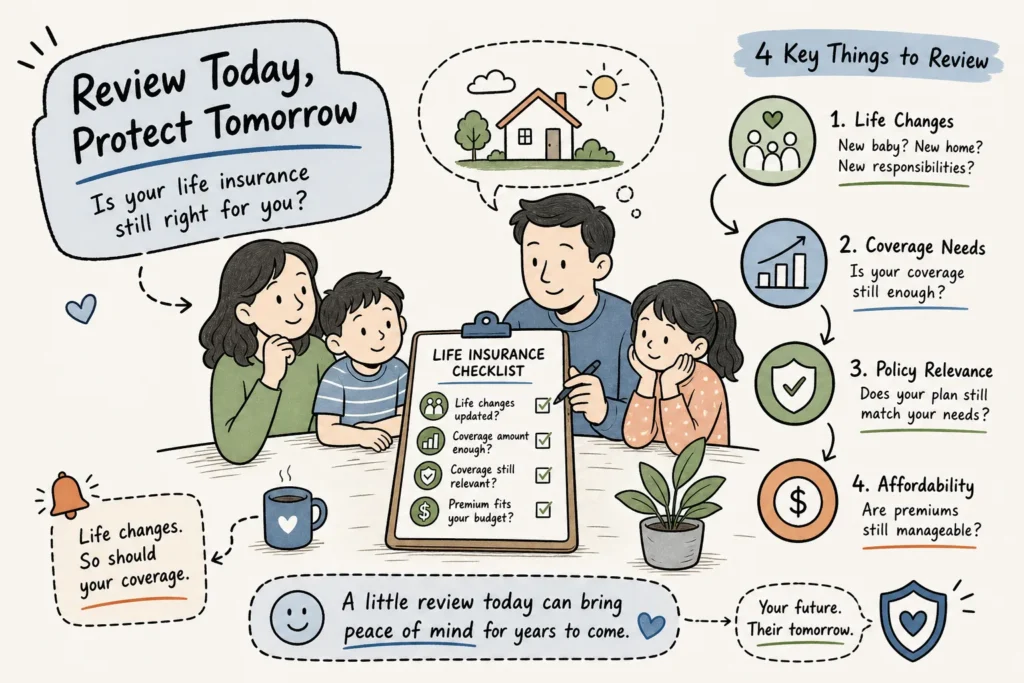
Annual reviews are the baseline. Certain life events, however, demand an immediate reassessment regardless of when you last looked at your policy. Waiting for the calendar to prompt you is not sufficient when your financial responsibilities have changed overnight.
Marriage creates financial interdependence almost immediately. If your spouse relies on your income, your sum assured needs to reflect the lifestyle you are now jointly building. A review within 60 days of marriage is widely cited as good advisory practice. Divorce works in the opposite direction: beneficiary designations do not update automatically, meaning an ex-spouse could still be named as primary beneficiary on a policy taken out years ago. Both events require an immediate review of coverage amount, beneficiaries, and policy ownership.
The arrival of a child and the commitment of a home loan are arguably the two events that most materially change your insurance needs, and they often coincide for Malaysian families in their thirties. A child introduces 18-plus years of financial dependence. A mortgage introduces a debt that your family could lose the roof over if your income stops suddenly. Neither obligation is adequately addressed by the policy most people took out when they were younger, unattached, and renting.
Career progression matters too. A promotion or move to a higher-paying role means your income replacement needs to scale accordingly. Conversely, someone approaching retirement may find that certain protection is no longer necessary, children are now financially independent, the mortgage is settled, while other needs, such as critical illness cover or legacy planning, become far more relevant. If you are thinking specifically about estate and legacy issues, see our wealth advisory service to align insurance with your broader plans.
How to review life insurance coverage: calculating whether your sum assured still makes sense
A vague sense of “I should probably check my policy” is not enough. You need a concrete framework to assess whether your current coverage actually closes the gap it is supposed to close.
Start with the income replacement method. Multiply your monthly income by 12, then by the number of years your dependants would need financial support. For a household earning RM6,000 per month needing 20 years of coverage, the income replacement figure alone is RM1,440,000. To that, add all outstanding debts: home loan, car loan, credit card balances. Add a dependants buffer of approximately RM50,000 per child, a commonly used rule of thumb among Malaysian financial planners, to cover education costs and transition expenses. The 10x annual salary rule of thumb is a reasonable starting point, but it tends to underestimate needs for larger households carrying significant debt.
From that total, subtract existing assets: your EPF savings, unit trust holdings, and any other policies already in force. The figure that remains is your net coverage gap, the amount your life insurance sum assured needs to address.
One further step is worth taking: stress-test that number against inflation. At a conservative 4% annual inflation rate over a 20-year coverage horizon, a RM1,000,000 payout is worth roughly RM456,000 in today’s ringgit, less than half its nominal value. That erosion is material, and it needs to be built into your planning. Note also that while SOCSO does provide a funeral benefit of up to RM2,000 (subject to eligibility under PERKESO guidelines), private funeral arrangements in Malaysia typically cost considerably more; build that gap into your calculation as well.
A practical checklist to review your life insurance policy
Use the following items to structure your review. Each one corresponds to a common gap that gets overlooked when policies are left unexamined for years.
Coverage, premiums, and riders:
- Sum assured: Does it cover your current income replacement need, outstanding debts, and dependants buffer after offsetting existing assets?
- Premium affordability: Is the current premium sustainable, and given your current health profile, could you access equivalent cover more efficiently?
- Riders: Are your supplementary benefits, critical illness, total permanent disability, waiver of premium, still relevant to your life stage? Have you checked whether your insurer has introduced new options you have not yet activated?
Beneficiaries, ownership, and exclusions:
- Beneficiaries: Are your primary and contingent beneficiaries current? Has a marriage, divorce, or bereavement changed who should be named?
- Policy ownership: Is the policy structured correctly for estate planning purposes, particularly if you hold business interests? If you are concerned about unintentionally transferring wealth, our wealth advisory service can help you structure ownership and nominations to avoid common pitfalls.
- Exclusions: Do you clearly understand what your policy does not cover? This is frequently the section policyholders have never actually read, and real cases where policies do not pay illustrate why this matters.
Policy term and fund performance:
- Policy term: If you hold a term policy, when does it expire? You need to decide whether to renew, convert to permanent cover, or purchase a new policy before a lapse in protection occurs.
- Fund performance: For investment-linked policies, is the underlying fund performing in line with expectations? Is there sufficient cash value to sustain the policy through to your intended coverage end date?
Updating or switching your cover in Malaysia: what to expect
Once you have identified a gap, you need to know how to close it. Insurers typically require the original policy document, a valid MyKad, and a written application form specifying the desired change. Increases in sum assured or the addition of riders will generally trigger new underwriting requirements, which may include a medical examination or an updated health declaration. This is one reason why acting sooner rather than later works in your favour: the younger and healthier you are when you request an upgrade, the more straightforward that process tends to be.
Not every coverage gap can be addressed through an upgrade to an existing policy. Where the original policy was poorly structured or carries high charges, a clean switch to a new policy may be the better outcome. Three factors dominate: your age and health at the time of switching; the risk of a coverage gap during transition; and whether a new policy restarts an exclusion period for pre-existing conditions. One rule to follow without exception: never cancel an existing policy before a replacement is confirmed and in force.
Why an objective insurance review changes the outcome
The structural problem with commission-based advice on insurance is straightforward. An agent or adviser who earns a commission on products sold has an inherent incentive to recommend more coverage, or a product with a higher commission margin. This does not mean every agent is acting dishonestly, but the conflict of interest exists regardless of intent. When you ask someone with a financial stake in the outcome whether you are overinsured, the answer is unlikely to be yes.
At CF Lieu, the insurance needs analysis works differently because the practice operates on a fee-only basis, with no commission received on any product recommended. A review involves a full assessment of your current policies against your actual income replacement needs, outstanding debts, and financial goals. The recommendation may be to increase coverage, reduce it, restructure your riders, update your beneficiaries, or do nothing at all. The advice is shaped entirely by what the numbers show.
For anyone who has not taken the time to review life insurance coverage in recent years, or who has experienced a significant life change, this kind of independent, objective review removes the guesswork and gives you genuine clarity on where you stand.
Where to go from here
To review your life insurance coverage is not a one-time task. It is an ongoing responsibility that should move with your life. Annual reviews, triggered immediately by any significant life event, are the standard that sound financial planning practice demands and that every major insurer in Malaysia recommends.
Most people find the review more useful, and more revealing, when it is done with someone who has no financial stake in what they recommend. An independent, fee-only adviser has no incentive to recommend more cover than you need, or less. If you are unsure where your current cover stands, or if your life has changed materially since you last looked at your policy, a free initial assessment with CF Lieu is a practical next step. There is no product pitch, just an honest look at whether your coverage still fits the life you are actually living.
FAQs: Insurance Needs Analysis that actually matters
How often should I review my life insurance coverage in Malaysia?
Annual reviews are the baseline recommended by major insurers and advisers, and firms like AIA, Prudential and FWD advise customers to check their cover every year. Bank Negara Malaysia also encourages coverage that aligns with your current financial circumstances rather than the situation when you first bought the policy. Certain life events, however, require an immediate reassessment regardless of the calendar.
What life events should trigger an immediate life insurance review?
Review your policy immediately after major life events such as marriage (recommended within 60 days), divorce, the arrival of a child, taking on a home loan, or a significant career promotion. These events change income needs, dependants and debt exposure, and waiting for an annual review may leave gaps in protection.
How can I tell if my sum assured is still sufficient?
Compare your current income-replacement need and outstanding debts with the sum assured — your cover bought when single and debt-free is unlikely to be enough once you have a mortgage, children or a much higher salary. If your financial responsibilities (for example a RM450,000 home loan or multiple school-age children) or income have increased materially, you should top up cover or adjust the policy to match those figures.
What practical checklist should I follow when reviewing my life policy?
Check the sum assured versus current income-replacement and outstanding debts, verify beneficiary designations and policy ownership, confirm premium affordability and review policy type and riders. Also inspect exclusions, the protection component (especially for investment-linked plans), and any recent fund statements or policy illustrations to ensure they reflect today’s needs.
How do I update or increase my life insurance after a review?
Contact your insurer or an adviser to request changes — typical actions include updating beneficiaries or ownership, applying for a higher sum assured (which may require medical underwriting), or buying an additional policy or rider. Get written confirmation of any change and compare quotes from multiple providers if you decide to top up or switch products.
Do investment-linked policies need special attention during a review?
Yes — investment-linked policies often send quarterly fund statements that get filed without questioning whether the protection element still matches your needs. Because the investment and protection components are separate, you should specifically review the protection level rather than assuming the policy’s existence alone is sufficient.
Who should I consult to review my life insurance in Malaysia?
Independent financial advisers and qualified planners commonly find coverage built for a life the client no longer lives; professionals such as CF Lieu, can run a full assessment. You can also contact your insurer directly, but an independent review helps ensure recommendations focus on your current needs rather than the product you already own.
Related Insurance Guides
A coverage review usually leads to one of these decisions. Each guide goes deeper on one step:
- Insurance needs analysis: how much cover is enough
- Best medical cards in Malaysia compared
- Why medical insurance premiums keep increasing
- When to replace an existing insurance plan
- Risks to check before switching insurance policies
- Is cancelling an old policy financially sensible?
- Insurance savings plan vs fixed deposit in Malaysia
- Independent insurance review and advisory with CF Lieu
