
Two Malaysians can both sign up for a “retirement planning package” and end up with completely different experiences. One receives a personalised 30-year income roadmap with a stress-tested withdrawal strategy, documented EPF coordination, and a confirmed schedule of annual reviews. The other receives a new insurance policy and a glossy brochure filed away in a drawer. The problem is not a shortage of advisory services in Malaysia; it is the absence of any standard definition for what these packages actually contain.
This guide cuts through that ambiguity. By the end, you will know what a credible retirement advisory engagement should include, how Malaysia-specific vehicles like EPF and PRS fit into the picture, what different pricing models cost you in real terms, and the questions worth asking before you commit to any provider. Understanding the full range of retirement planning packages offered by financial advisory firms, and what separates a genuine plan from a rebranded product proposal, is the first step toward making a well-informed decision. CF Lieu Advisory serves as a reference point throughout for what a well-structured, transparent retirement advisory offering genuinely looks like in practice.
Table of Contents
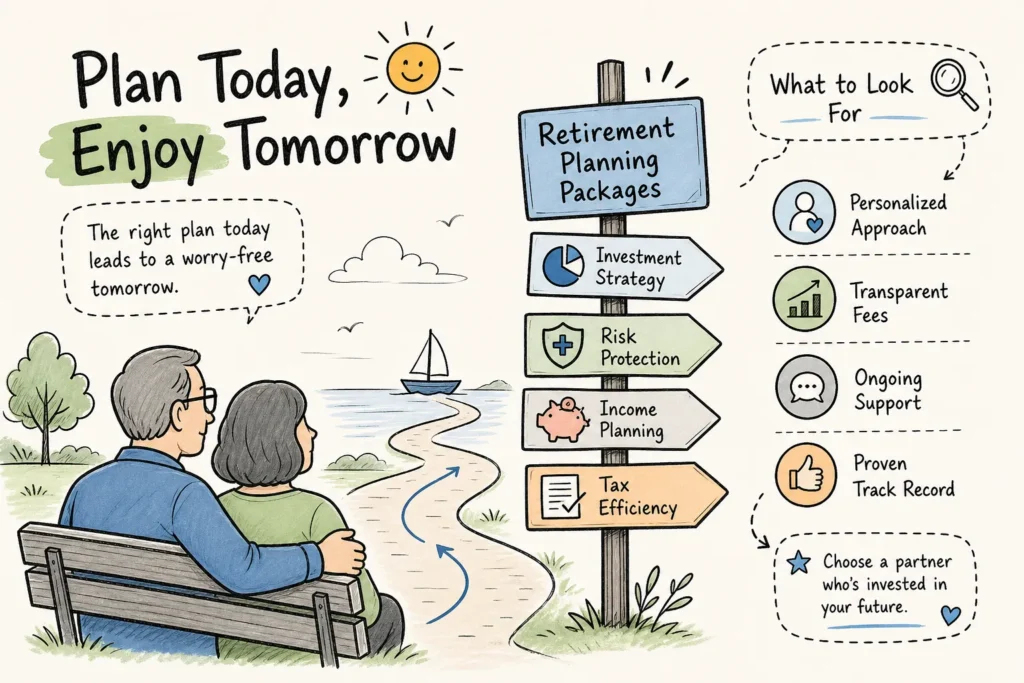
What a proper retirement planning package covers
Any credible retirement advisory package is built on 6 core pillars:
- retirement income projection,
- cash flow planning,
- tax-efficient withdrawal strategy,
- investment portfolio alignment,
- insurance needs review, and
- estate or legacy coordination.
Industry guidance from bodies such as the Financial Planning Association of Malaysia (FPAM) consistently identifies these components as the foundations of a coherent retirement strategy, they are not optional extras or premium add-ons reserved for high-net-worth clients. Omitting even one creates a blind spot with potentially serious consequences across a 30 to 40-year planning horizon.
The services matter, but so do the tangible deliverables. A genuine retirement engagement produces outputs you can read, revisit, and act on: a written retirement income plan, an investment policy statement, a documented EPF and PRS withdrawal strategy, and a confirmed schedule for annual reviews.
Advice delivered verbally across a single meeting is not a retirement plan; it is a consultation. Without documented deliverables, you have nothing to hold the adviser accountable to as your circumstances evolve.
Some packages are stripped down to investment management alone, quietly leaving out tax planning, insurance review, and estate coordination. This is a common gap that leaves clients with a portfolio strategy but no income replacement plan.
An optimised portfolio that is not coordinated with your EPF withdrawal timing, insurance coverage, and legacy wishes is an incomplete solution, regardless of how well the investments themselves perform.
What a sample retirement planning package should include
To give you a concrete sense of what thorough adviser service offerings look like, a properly scoped retirement plan typically covers the following:
- A written retirement income projection over a defined time horizon (commonly 25 to 40 years)
- A cash flow analysis covering pre-retirement accumulation and post-retirement drawdown
- An EPF and PRS withdrawal strategy with documented timing recommendations
- A tax-efficient decumulation plan aligned with the client’s marginal rate
- An investment policy statement with asset allocation and rebalancing guidelines
- An insurance and risk coverage review relative to the retirement income gap
- An estate coordination summary covering nomination of beneficiaries and legacy intent
- A confirmed schedule of annual reviews with defined review triggers
If a package you are evaluating does not produce most of these in writing, it is reasonable to ask why, and to treat the gap as a signal about the depth of the engagement on offer.
How EPF, PRS, and annuities work together in your retirement strategy
Malaysian retirement planning has its own structural hierarchy, and any competent adviser must treat EPF, PRS, and annuities as a coordinated system rather than three separate products. A thorough package shows you how they interact, not just what each one does in isolation.
EPF: the foundation of your retirement income
EPF forms the foundation of every employed Malaysian’s retirement income strategy. A serious advisory engagement addresses the full picture: the Sub-Account A and B split, full withdrawal eligibility at age 55, and how EPF integrates into your broader income replacement approach. EPF historically provides stable, dividend-based returns managed by the fund itself, though these are declared dividends rather than statutory guarantees, EPF’s long-term track record makes it the natural anchor for most Malaysian retirement plans. The adviser’s job is to show you how it connects to everything else.
Note on tax relief: EPF and life insurance premiums share a combined annual tax relief cap under the Income Tax Act 1967. The precise applicable limits under Section 49 should be confirmed against the current year’s LHDN (Inland Revenue Board) assessment guidelines, as these figures are subject to legislative revision. Your adviser should present the current statutory amounts clearly and in writing.
PRS and annuities: pension planning solutions for the gaps EPF cannot fill
PRS complements EPF with a separate annual tax relief cap (currently RM3,000 under LHDN guidelines), offering market-linked exposure across equity and mixed-asset funds. It is particularly relevant for self-employed individuals who lack employer contributions and for those seeking additional pension planning solutions beyond what EPF alone provides. A thorough package models PRS alongside EPF to show the combined retirement financial runway, not just the projected balance of each account viewed separately.
Annuities and pension packages serve the income-generation phase, converting an accumulated lump sum into predictable monthly cash flow with longevity protection. Deferred annuities share the same RM3,000 tax relief cap as PRS under current LHDN rules, so the allocation between the two requires deliberate planning rather than guesswork. A good adviser maps when and how this conversion should happen, not just how much you need to accumulate before you stop working. Together, EPF’s stable base, PRS’s market-linked growth, and annuity income protection form a complementary three-tier structure that a well-designed retirement plan coordinates explicitly.
Flat-fee vs commission: the pricing model shapes the advice, not just the bill
Many clients evaluating retirement advisory services do not realise that how an adviser gets paid directly influences what they recommend. The pricing model is not a billing formality, it is the central factor that determines whether the advice you receive is genuinely unbiased or quietly constrained by revenue considerations.
Fee-based advisers charge a fixed professional fee. In Malaysia, a comprehensive retirement plan from a licensed fee-only planner typically costs between RM2,000 to RM10,000+ for a one-off engagement. Hourly rates for licensed planners generally range from RM500 to RM1000. AUM-based annual fees, where applicable, typically run from 0.5% to 1.5% of assets under management. CF Lieu Advisory operates on exactly this flat-&-fixed fee model: the fee is declared upfront, and every recommendation is driven by the client’s retirement objectives, not by what generates a payout from a product provider.
Commission-based advisers often present their retirement planning services as free. In practice, a 3% to 5% upfront sales charge on every product recommended quietly erodes portfolio value, a front-end charge of this magnitude on a long-term investment can meaningfully reduce compounded returns over a 20- to 30-year horizon. The advice may be broadly suitable, but it is rarely unbiased: the product range is limited to what generates a commission for the adviser’s firm. Knowing these benchmarks prevents you from confusing “no upfront fee” with “no cost.”
The real difference between a retirement plan and a product sale
Many Malaysians have been handed something labelled a retirement plan that is, functionally, an insurance or unit trust proposal with supporting calculations attached. The difference is not always visible from the outside, but qualifications and legal obligations make it clear once you know what to look for.
A legitimate retirement financial adviser in Malaysia holds either a Financial Adviser Representative (FAR) licence from Bank Negara Malaysia or a Capital Markets Services Representative Licence (CMSRL-FP) from the Securities Commission, and ideally holds a CFP (Certified Financial Planner) designation from FPAM. These are not cosmetic credentials; they carry legal obligations and professional standards that tied agents are simply not held to. A tied agent typically holds a product-selling certificate such as the CEILI or CUTE qualification, not a financial planning licence, and operates under a different standard of care toward your retirement outcomes.
Under the Capital Markets and Services Act and BNM’s Financial Services Act framework, licensed investment advisers and FA representatives are expected to act in the client’s best interest. A tied agent operates under a suitability standard, meaning a recommendation only needs to be broadly appropriate for the client’s general profile, a meaningful legal distinction with real consequences for the objectivity of the retirement advice you receive over a multi-decade planning horizon.
The most reliable red flag is this: if the retirement plan is presented as part of the product application process, the plan was built around the product, not around you. A genuine adviser completes a thorough discovery process, builds the plan, and then determines whether any product is even required to address the gaps identified.
Questions to ask before signing with any retirement advisory firm
Knowing what to look for is only useful if you know how to verify it. The three areas below allow you to vet any advisory firm with confidence, covering compensation, scope and deliverables, and qualifications, whether you are evaluating CF Lieu or any other provider.
Start with compensation. Ask directly: “How do you get paid, and from whom?” A transparent adviser answers this without hesitation. Follow up by asking whether they earn any form of compensation from the products they recommend. A flat-fee, commission-free adviser can answer both questions cleanly and immediately. Any vagueness on this point is itself a useful signal about how the rest of the engagement will be handled.
Next, ask about scope and deliverables. Find out what the package produces in writing, how often the plan is reviewed, and whether the quoted fee covers subsequent reviews or charges separately for each follow-up meeting. A strong engagement produces a documented retirement income plan, not just a series of informal conversations with no paper trail.
Finally, verify qualifications and independence. Confirm the adviser’s licence via BNM’s Financial Adviser Registry or the SC’s CMSRL database. Ask how long they have been practising and whether they have experience with clients in a similar financial position to yours. Independence matters: an adviser tied to a single institution cannot objectively compare all the options available to you, regardless of how credible that institution is.
Your next step toward a plan that actually holds up
Retirement advisory services in Malaysia exist on a wide spectrum, from a fully independent, documented retirement income roadmap to a rebranded product proposal with a planning label attached. The difference is not always obvious from the outside, but the criteria covered here make it easier to distinguish one from the other: scope of services, pricing model, qualifications, fiduciary duty, and the quality of what is delivered in writing.
The range of retirement planning packages offered by financial advisory firms in Malaysia varies significantly in depth, independence, and value. Knowing what to expect, and what to demand, puts you in a far stronger position when you sit across from any adviser.
If you are ready to see what a genuine, flat-fee retirement advisory engagement looks like for your specific situation, CF Lieu is available to assess your current position and outline exactly what a properly structured plan would need to address, from your EPF and PRS coordination to your income replacement strategy and estate considerations.
The earlier you get a clear picture of your retirement runway, the more options you have to adjust course before those adjustments become urgent. A well-structured plan does not just tell you whether you are on track, it shows you precisely what “on track” looks like for your income, your timeline, and your life.
➡️ 10 Questions to assess your Financial Readiness Test for Retirement / Career Break:
➡️ Want a licensed advisor to independently plan, validate, and optimize your early retirement numbers without the sales talk?
Here to schedule an assessment call
▶️ Or want to run the numbers yourself without talking to anyone?
Tap Here to quickly use our web app to build and stress-test your retirement roadmap in the next 5 min