
This is the master guide to building a retirement income plan in Malaysia — turning your savings into reliable monthly income. If you haven’t worked out how much income you need yet, start there; if longevity is your main worry, see the 30-year retirement income plan.
The fear most Malaysians carry into retirement is not the act of stopping work, it is running out of money five, ten, or fifteen years after they stop. Without a clear retirement income plan, you can spend decades building a nest egg and still arrive at 60 with a lump sum and no structured approach to converting it into reliable monthly income. That gap between having savings and having a sustainable income strategy is where retirement plans quietly fail.
Life expectancy in Malaysia has risen steadily. According to the Department of Statistics Malaysia, a man who reaches age 60 today can expect to live another 18.9 years, while a woman at the same age has an average remaining life expectancy of 21.8 years. Build in a reasonable buffer for longevity, and a minimum 20-year planning horizon is not pessimistic, it is prudent. Your retirement savings need to work as income for longer than most people assume when they first sit down to plan.
This guide, which is part of my complete retirement planning guide for Malaysia, covers 4 things: how to calculate the monthly income target you actually need; how EPF and pension income form your base layer; which product structures work for Malaysian retirees and what each one costs you in flexibility or certainty; and how to sequence withdrawals so the money lasts. If you have never had this mapped out in a single, stress-tested plan, the kind of structured approach offered by CF Lieu on a flat-fee, commission-free basis is worth understanding before you finalise anything.
Table of Contents
How much monthly income do you actually need in retirement?
Setting your income replacement target
The standard starting point in any retirement income plan is the income replacement ratio. As a widely used planning rule of thumb, most retirees need roughly 70 to 80 percent of their pre-retirement income to maintain their lifestyle, because mortgages, commuting costs, and career expenses typically fall away. High earners often find their needs sit at the lower end of that range, while those with dependants or ongoing financial commitments may need more. The Manulife Investment Management benchmark puts a comfortable Malaysian retirement lifestyle at approximately RM5,871 per month, a useful anchor when translating an abstract savings target into a concrete number.
The problem is that many working Malaysians are not saving toward that figure. The same Manulife research found that many expect their retirement income to be less than one-third of their current earnings, a significant gap relative to the benchmarks planners use. Starting with a specific monthly income target, rather than a vague goal to “save more,” is what turns a retirement income plan from a wish into a working financial strategy.
How to Build a Retirement Income Plan: Monthly Targets and Inflation
Adjusting for inflation over a 20-year horizon
A retirement cash-flow plan that ignores inflation is one that shrinks every year by design. Malaysia’s average annual inflation rate over the past decade has been approximately 2.5 percent. Many financial planners working with 30-year projections use a 3 to 4 percent assumption as a conservative margin, a general industry heuristic rather than an official figure, but one that reflects the compounding uncertainty of a multi-decade horizon. At 3 percent annual inflation, RM5,000 in purchasing power today requires roughly RM12,000 per month in 20 years to buy the same basket of goods and services. For current CPI figures and historic trends, see Malaysia’s published inflation data.
This is not a theoretical problem. It is the mechanism by which a seemingly adequate retirement income becomes genuinely insufficient by the time a retiree reaches their mid-70s. Every income structure you build needs to be tested against an inflation-adjusted withdrawal schedule, not just the figure that feels comfortable at the point of retirement.
Translating your target into a savings figure
The mathematics of turning a monthly income target into a required savings pot changes significantly with the assumed real return. Using a 4 percent real return assumption, every RM100,000 in retirement savings can support approximately RM499 per month over 25 years. To sustain RM6,000 per month for 25 years at that same return rate, you need roughly RM1.2 million in investable assets, separate from EPF and pension income. At a more conservative 2 percent real return, the required pot is materially larger. These numbers are meant to make the savings target concrete so that every other planning decision has a clear anchor, not to alarm, but to focus.
EPF and pension: the foundation of your income plan
How EPF withdrawals work at retirement
For most Malaysians, EPF is the single largest retirement asset, which makes the withdrawal decision disproportionately important. At retirement age, members can access their savings through EPF’s i-EMAS programme, which provides a monthly drawdown option rather than a one-time lump sum. This is a meaningful structural choice: taking a scheduled monthly payment preserves the discipline of drawing only what you need, while leaving the remaining balance invested with EPF’s declared dividend.
The EPF three-account restructuring introduced Akaun Fleksibel, Akaun Sejahtera, and Akaun Persaraan as separate pools with different access rules. In 2026, the practical effect is that this restructuring changes the default flow of savings rather than eliminating existing withdrawal rights. Existing members retain their access under the current framework, and the new retirement-income account is designed to disburse monthly once a member reaches retirement age. The Ministry of Finance has clarified that the proposed monthly payout plan will not affect current withdrawal entitlements, which is important context when modelling future cash flows (MOF press statement).
Tax rules that affect your net retirement income
EPF withdrawals made at the qualifying retirement age are generally exempt from income tax, which means the full gross amount is available as spendable income, a significant advantage compared to some other retirement structures. During the accumulation phase, Private Retirement Scheme (PRS) contributions attract a tax relief of up to RM3,000 per year, available through 2030, which effectively reduces the after-tax cost of building supplementary retirement savings alongside EPF.
Building EPF and pension as your base income layer
Think of EPF and any pension entitlement as the guaranteed floor of your retirement income structure: predictable, low-risk, and the first source to draw from in the early years of retirement. Every well-designed retirement income plan places this base layer first, followed by a supplementary layer from investments and unit trusts, and an emergency buffer that sits outside the regular drawdown structure. For example, a retiree whose EPF monthly drawdown covers 60 percent of essential living costs is in a meaningfully stronger position than one who must immediately draw on investment assets to meet basic needs. The base layer does not need to cover everything, it needs to cover enough that your supplementary layers are not under immediate pressure.
Retirement income product types: what works and what to watch for
Annuities and guaranteed payout plans
An annuity converts a lump-sum premium into regular income payments, either for a fixed term or for the rest of your life. The core advantage is longevity protection: a life annuity eliminates the risk of outliving your capital because the insurer bears that risk in exchange for the premium. For retirees who want the certainty of a fixed monthly amount regardless of market conditions, this structure has genuine value.
The trade-offs are real, however. Annuities typically offer lower liquidity once the policy is in force, carry embedded insurer margins that reduce the effective return, and pay a fixed nominal amount that loses purchasing power if the contract does not include an inflation-escalation clause. A Malaysian life annuity purchased at 65 will pay the same nominal ringgit amount in 20 years, by which point inflation will have materially eroded its real value.
Systematic withdrawals and unit trust drawdowns
A systematic withdrawal strategy keeps your retirement capital invested in a diversified portfolio of unit trusts, equities, or bonds, and draws a scheduled monthly amount from that pool. The advantage over an annuity is flexibility: you retain access to the capital, can adjust the withdrawal amount, and benefit from portfolio growth that helps maintain purchasing power over time. Research on safe withdrawal rates for a 20-year horizon consistently points to the 3.5 to 4 percent range as a sustainable starting point, adjusted annually for inflation.
The primary risk in this structure is sequence-of-return risk. If markets fall sharply in the first few years of retirement while you are simultaneously drawing income, the portfolio may be permanently impaired even if markets recover later. This is why a systematic withdrawal plan requires active management, annual reviews, and a guardrail strategy that adjusts withdrawal amounts based on portfolio performance thresholds.
Comparing structures across what matters most
No single product is optimal across all the dimensions that matter in retirement income planning: income certainty, longevity protection, liquidity, and cost. Annuities offer strong certainty and longevity protection but surrender most of your liquidity. Systematic withdrawals and unit trust drawdowns preserve flexibility and provide better inflation-hedging potential, but they carry market risk that an annuity does not. Life insurance payout plans sit between the two, offering scheduled income with some insurance protection, though typically with more limited flexibility and lower potential returns.
Most sustainable retirement income plans use a combination of at least two structures: a guaranteed base (annuity or EPF drawdown) to cover essential living expenses, and a more flexible investment layer to cover discretionary spending and protect against inflation. Getting this blend right is where professional input adds the most value.
Withdrawal sequencing for your retirement income plan
The order in which you draw from different accounts matters
Withdrawal sequencing refers to the deliberate choice of which accounts and assets to draw from first, and in what order. The general principle is to preserve tax-advantaged or growth-oriented assets for as long as possible. In practice, this means drawing from regular savings and non-EPF investment accounts in early retirement before accessing EPF drawdowns, and leaving equity portfolios to compound for as long as the plan allows. Drawing the wrong account first can cost years of portfolio longevity, even if the total amount saved is identical.
In a Malaysian context, this typically looks like using accessible savings and Akaun Fleksibel balances in the early retirement years, transitioning to EPF monthly drawdowns through i-EMAS, and allowing any growth-oriented unit trust or equity portfolio to run as long as possible before tapping principal.
Building passive income to reduce drawdown pressure
Every ringgit of passive income your portfolio generates is a ringgit of principal you do not need to sell. Dividend-paying equities, unit trust distributions, and rental income all serve this purpose, reducing the drawdown pressure on your capital and extending the life of the overall plan. The important discipline here is that passive income streams need to be built before retirement, not during it. The compounding and accumulation required to generate meaningful passive income takes years to establish, which is why the construction phase of a retirement income plan starts long before the drawdown phase begins.
Annual reviews keep the plan aligned with reality
A retirement cash-flow plan is not a document you file and forget. Inflation shifts your real income needs, markets move your portfolio value, and unexpected expenses test the buffer you built in. Annual reviews allow you to adjust withdrawal amounts, rebalance between income sources, and apply a guardrail strategy: reducing withdrawals temporarily when the portfolio drops below a defined threshold, and allowing slightly higher spending when it grows above another. This kind of active stewardship is what keeps a retirement income plan aligned with your actual life rather than the assumptions made at the outset.
Why the advice behind your plan shapes the income you actually receive
How commission-driven advice skews retirement product choices
An advisor who earns commissions from product sales has a structural incentive to recommend products that pay higher commissions. This does not mean every commission-based recommendation is wrong, but it creates a bias that the client cannot easily detect from a product illustration alone. The practical outcome is that many Malaysians end up with a collection of financial products rather than a coherent retirement income plan built around a specific monthly income target.
What a flat-fee retirement income plan looks like in practice
CF Lieu is a Certified Financial Planner and one of Malaysia’s few independent, flat-fee wealth advisors. The fee is paid directly by the client, which means the planning process is structured entirely around the client’s income target rather than around product margins. A retirement income engagement with CF Lieu covers the monthly income calculation, EPF and pension integration, supplementary income layer design, withdrawal sequencing, inflation stress-testing, and an annual review framework. Because there are no commissions involved, the recommendation to use an annuity, a systematic withdrawal strategy, or a blended approach is made purely on the merits of the client’s specific situation.
Three questions to ask before finalising any retirement income plan
Before you commit to any retirement income structure, work through these three questions.
- How is the advisor compensated? Does that compensation create any incentive to recommend particular products over others?
- Has the plan been stress-tested over a minimum 20-year horizon using a realistic inflation assumption of 3 percent or more?
- Does the plan sequence withdrawals in an efficient order that preserves growth assets for as long as possible?
If any of these questions does not have a clear answer, the plan is not finished.
Building a plan that outlasts you
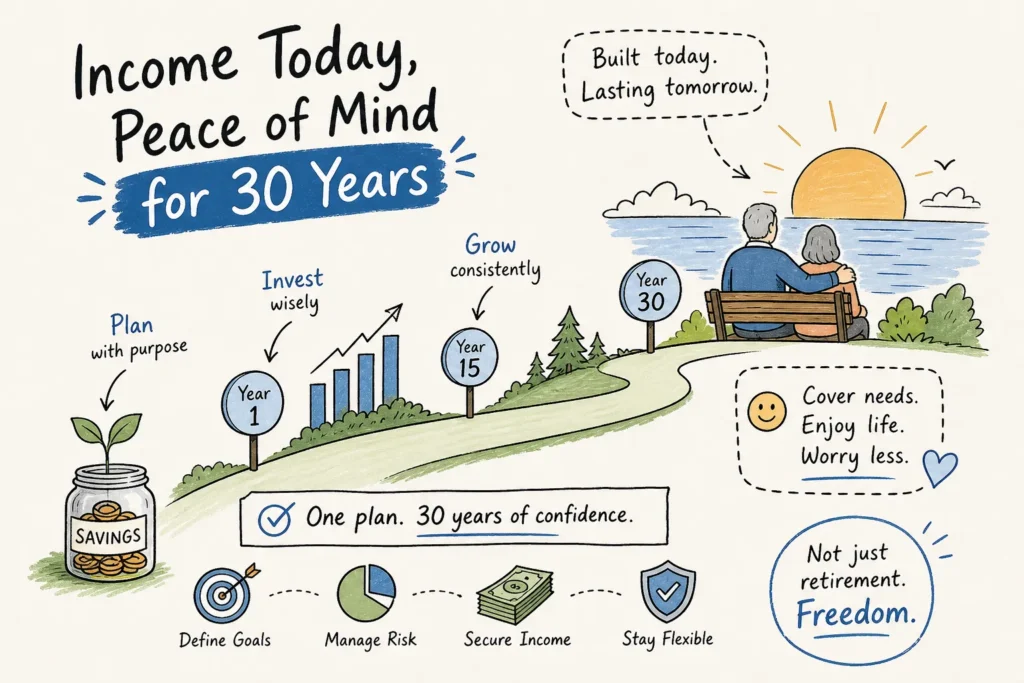
A retirement income plan that holds over 20 years rests on four pillars: a specific monthly income target adjusted for inflation, EPF and pension income as the guaranteed base layer, a well-chosen combination of product structures for the supplementary layer, and a deliberate withdrawal sequence that preserves capital for as long as possible. None of these elements work well in isolation, and none of them are set-and-forget.
A retirement income plan is not a product purchase. It is a living income strategy built around your actual cashflow requirements, one that needs to be revisited every year as circumstances change. The difference between a plan that holds and one that quietly falls apart is usually not the amount saved. It is the quality of the thinking behind how that amount is converted into reliable monthly income.
If you have not yet mapped your 20-year income strategy, or if you suspect the plan you have was designed around a product rather than your income needs, speaking with CF Lieu is a straightforward way to identify where the gaps are. As an independent, fee-based advisor, CF Lieu’s engagement is structured around your outcome, not a product sale. Reach out directly to find out how a structured retirement income plan can be built around your specific numbers.
➡️ 10 Questions to assess your Financial Readiness Test for Retirement / Career Break:
➡️ Want a licensed advisor to independently plan, validate, and optimize your early retirement numbers without the sales talk?
Here to schedule an assessment call
▶️ Or want to run the numbers yourself without talking to anyone?
Tap Here to quickly use our web app to build and stress-test your retirement roadmap in the next 5 min
FAQs: The Retirement Income Plan that actually matters
How much monthly income do I need to retire in Malaysia?
Most planners use an income replacement ratio of about 70–80% of pre-retirement pay, but needs vary by household. Manulife Investment Management benchmarks a comfortable Malaysian retirement at roughly RM5,871 per month, which is a useful starting anchor to turn a vague goal into a concrete target. For a personalised walkthrough, the article points to the guide titled how much is enough to retire in Malaysia.
How should I adjust my retirement income target for inflation?
You must test any income plan against inflation‑adjusted withdrawals over the full horizon; ignoring inflation causes real purchasing power to shrink each year. Malaysia’s average annual inflation over the past decade was ~2.5%, and many planners use a conservative 3–4% assumption — at 3% inflation, RM5,000 today needs roughly RM12,000 per month in 30 years to buy the same basket.
How do EPF and pension income fit into a retirement income plan?
EPF and any formal pension form the base layer of retirement cash flow and should be counted first when setting monthly income targets. The article emphasises using these steady income sources as the foundation before layering in drawdowns from savings, investments, or annuity‑style products.
What product structures work for Malaysian retirees and what trade-offs should I expect?
The article says different product structures (e.g., systematic withdrawals, annuities, phased drawdown strategies) offer varying mixes of flexibility and certainty. Generally, products that guarantee income cost you flexibility and potential upside, while flexible drawdown keeps control but increases longevity and market‑risk exposure.
How should I sequence withdrawals so my money lasts 30 years?
Sequence withdrawals to prioritise guaranteed income first (EPF/pension), then use low‑volatility or income‑producing assets for early years while leaving growth assets to fund later years. The article recommends stress‑testing withdrawal schedules against inflation and longevity to ensure sustainability rather than relying on a single lump‑sum plan.
Should I get professional help and what service model does the article mention?
If you haven’t mapped a single, stress‑tested plan, the article suggests considering a structured approach from a fee‑only adviser; it specifically highlights CF Lieu’s flat‑fee, commission‑free service as worth understanding before finalising plans. A professional can translate monthly targets, inflation assumptions, and product trade‑offs into a single retirement income strategy.
