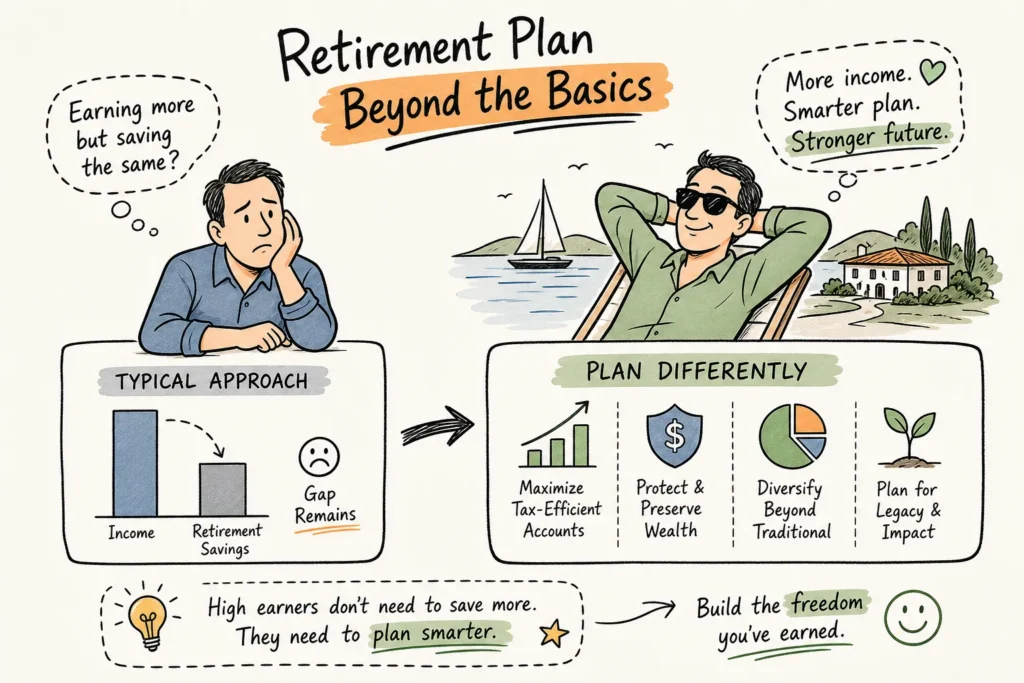
High earner retirement does not happen automatically, earning well is not the same as retiring well. Many high-income professionals arrive at their mid-fifties with impressive salaries, solid EPF balances, and a property or two, yet face a retirement income shortfall they never saw coming. The assumption that a high income automatically produces a secure retirement is one of the most expensive misconceptions in personal finance.
The reality is harder to swallow. Malaysia’s average income replacement ratio sits at just 30% of pre-retirement income, against the widely cited benchmark of 70% to 80%. For someone earning RM8,000 a month, that gap is manageable with careful planning, the absolute shortfall, while significant, falls within reach of disciplined saving and EPF accumulation. For someone earning RM25,000 or more, the numbers are far less forgiving: a 50-percentage-point shortfall on a RM25,000 monthly salary represents a monthly income gap of RM12,500, and statutory schemes like EPF were never designed to close that distance alone. The higher the income, the more the retirement burden shifts onto personal savings and private structures.
At CF Lieu, this is the exact challenge we work through with high-income professionals. The issues cluster around four areas that standard planning advice rarely addresses: lifestyle cost replacement, concentration in a single wealth vehicle, insurance coverage that has not kept pace with income growth, and withdrawal strategies that are either absent or poorly sequenced. Each of these deserves a closer look.
Table of Contents
High earner retirement maths most get wrong
The 80% income replacement rule sounds straightforward until you apply it to a senior executive earning RM30,000 a month. Replacing 80% of that salary requires generating RM24,000 monthly in retirement income, RM288,000 per year. At a conservative 4% withdrawal rate, that translates to a required retirement portfolio of approximately RM7.2 million. Generic retirement calculators calibrated for median earners grossly underestimate this target, and the gap between what high earners accumulate and what they actually need is wider than most appreciate.
What compounds the problem is the spending assumption. Many financial plans assume that lifestyle costs drop naturally once you stop working. For high earners, the opposite is often true. Private medical care, travel, club memberships, school fees for younger children, and family support commitments do not disappear with a payslip. If anything, the first decade of retirement frequently sees spending match or exceed working-life levels, a pattern well-documented among high-income retirees in practitioner literature.
Financial planners working with high-income clients typically recommend directing at least 15% to 20% of gross income annually into savings contributions, with the income replacement burden falling heavily on voluntary and private vehicles rather than statutory schemes. For those who start late or who have spent their peak earning years lifestyle-matching rather than saving, the required savings rate climbs higher still. The maths is unforgiving, but it is fixable with the right structure and enough runway.
The single-vehicle trap that quietly derails retirement plans
A large EPF balance, a leveraged property portfolio, or a concentrated position in company shares each feel like financial progress. Relying on any one of these as your primary retirement vehicle, however, introduces a fragility that only becomes visible when it is too late to correct. Markets fall. Property markets stagnate. Company shares lose value. A single-vehicle retirement has no buffer when the primary asset underperforms precisely when you need it most.
Sequence-of-returns risk amplifies this problem significantly for high earners. A well-documented finding in retirement planning research is that the first decade of drawdown disproportionately shapes a portfolio’s final outcome, some studies attribute as much as three-quarters of the terminal value to returns experienced in those early years. A poor sequence of returns early in retirement, combined with large lifestyle withdrawals, can permanently impair a portfolio’s longevity. Because high earners withdraw more in absolute terms, they are disproportionately exposed to this risk compared to the average retiree.
A genuinely diversified retirement structure for a high-income professional typically spans multiple coordinated vehicles: voluntary EPF top-ups (which carry a tax relief of up to RM4,000 per year under current LHDN guidelines), a Private Retirement Scheme allocation (tax relief capped at RM3,000 annually), a self-directed investment portfolio, property generating passive income, and potentially a business interest or equity stake. Owning these vehicles is the easier part. Coordinating them into a coherent, sequenced drawdown strategy that minimises tax drag and prevents income gaps is where most high earners fall short.
High earner retirement: tax-efficient strategies worth stacking
Most high earners claim the obvious tax reliefs but leave the more powerful options untouched. Voluntary EPF contributions, PRS allocations, and private insurance with investment components each carry their own incremental tax benefits. Stacking these systematically over a 10 to 20 year accumulation phase, rather than approaching them as annual ad hoc decisions, compounds meaningfully. At a marginal tax rate of 26% to 30%, the band applicable to higher personal income in Malaysia, the RM3,000 PRS relief alone generates an immediate tax saving of between RM780 and RM900 before any investment growth is counted. (The precise figure depends on your assessed marginal rate; consult the current LHDN tax schedule to confirm the applicable band.)
Defined benefit-style structures for business owners
For self-employed professionals and business owners, the opportunity set extends further. Defined benefit-style structures, similar in principle to cash balance plans used in other jurisdictions, allow contribution levels that far exceed standard thresholds. A cash balance plan works by crediting a notional account annually based on a fixed percentage of salary and a guaranteed interest rate, entirely separate from market performance. For business owners in their fifties seeking to accelerate retirement savings significantly, these structures can shift the trajectory of a retirement plan in ways that voluntary EPF contributions simply cannot match.
Insurance coverage that actually matches your lifestyle exposure
A significant proportion of high-income professionals have insurance policies they set up early in their careers and have not revisited since. A life policy taken out on a RM5,000 monthly salary provides wholly inadequate coverage on a RM20,000 monthly salary. The gap between insured income and actual income is one of the most overlooked retirement risks at this income level, particularly for disability and critical illness coverage, where the financial consequences of an event can permanently derail a retirement plan.
Financial planners working with high-income clients in Malaysia broadly recommend life cover of 10 to 15 times annual income for those with dependants, though actual cover should always be personalised to individual circumstances. For someone earning RM240,000 per year, that translates to indicative coverage of between RM2.4 million and RM3.6 million. Critical illness cover, ideally in the range of RM200,000 to RM500,000, provides a capital buffer that prevents retirement savings from being liquidated to fund medical costs during the most financially vulnerable years. Disability income insurance is arguably the most critical component for high earners, because their human capital, not their accumulated savings, remains their largest asset through most of their working lives.
Insurance is not a standalone product purchase. It is a risk management layer that protects the retirement plan itself. An adequate insurance structure means a serious health event does not force an early drawdown of investment assets at the worst possible time, preserving both the plan’s longevity and the retiree’s quality of life without compromise.
Withdrawal strategies that protect retirement income for 30 to 40 years
The order in which you draw from different accounts across a 30-year retirement determines how much tax you pay in total, how long your portfolio lasts, and whether your income sustains the lifestyle you planned for. Drawing from taxable accounts first, then tax-deferred vehicles, and reserving tax-free assets for later years is a well-established sequencing principle supported by considerable practitioner research. Applied correctly over a multi-decade retirement, it can extend portfolio longevity by years and meaningfully reduce total tax paid.
The period between leaving full-time employment and the point at which mandatory EPF withdrawals or other statutory distributions begin is a strategic window that most retirees ignore. Income during this gap is lower, which compresses the effective tax bracket. This is the ideal window to reposition assets, execute partial conversions, or restructure holdings at lower cost. High earners who plan this gap period deliberately avoid the tax spike that catches many by surprise when multiple income streams activate simultaneously.
A sustainable withdrawal rate for a 30 to 40 year retirement is lower than most high earners intuitively assume. Factoring in inflation, healthcare cost escalation in private facilities, and the possibility of supporting family members well into retirement, the cashflow stress-test is non-negotiable before any retirement date is confirmed. Modelling withdrawals against realistic longevity assumptions, rather than optimistic ones, is what separates a plan that holds from one that fails in the late stages of retirement, when the ability to course-correct is most limited.
Why a bespoke high earner retirement roadmap is non-negotiable
A one-size-fits-all retirement plan assumes a predictable income, a single employer, a straightforward asset base, and a standard withdrawal timeline. High earners have none of these. Multiple income streams, diverse asset classes, complex insurance structures, longer retirement horizons, and often a business interest or directorship make a template-based plan structurally inadequate. The risk is not just that a generic plan underperforms, it is that it fails to identify the specific gaps that could unravel a carefully accumulated position.
At CF Lieu, the retirement roadmapping service is built specifically for high-income professionals whose wealth is spread across multiple vehicles with no cohesive strategy connecting them. Rather than optimising each vehicle in isolation, the approach coordinates contributions, sequencing, insurance adequacy, and income sustainability into a single, stress-tested plan. The service operates on a flat-fee, commission-free basis as a matter of firm policy, so the recommendations are shaped by what serves your long-term financial position rather than by product sales incentives.
A high earner retirement roadmap starts with a comprehensive picture of current assets, income, liabilities, and projected lifestyle costs. From there, gaps are identified, vehicles are coordinated, and a sequenced drawdown strategy is built with documented assumptions that can be reviewed and adjusted over time. This is not an annual review exercise dressed up as a plan. It is a structured document you can act on with confidence across a 30-year horizon.
The bottom line
High earner retirement planning is qualitatively different from what works for the average professional. The lifestyle cost replacement burden is heavier, concentration risk is real, insurance frequently lags behind income, and withdrawal strategy can make or break a portfolio over three decades. None of these challenges are unsolvable, but they require strategies built for this income profile, not adapted from planning tools calibrated for a median earner.
The tools available at higher income levels are genuinely more powerful: voluntary EPF top-ups, PRS contributions, private investment portfolios, advanced tax sequencing, and bespoke insurance structures. The value lies not in owning these vehicles individually but in coordinating them into a plan that is coherent, stress-tested, and sustainable across the full length of your retirement.
If your wealth is spread across multiple vehicles but you do not have a plan that connects them, that is the gap most worth addressing first. A clear high earner retirement roadmap built around your actual numbers, your actual lifestyle costs, and your actual timeline is where the conversation begins. That conversation starts with a complimentary initial assessment, reach out to CF Lieu to begin.
FAQs: Retirement for High Income Earners
Do high earners need to plan for retirement differently than average earners?
Yes. The article explains that high income does not automatically equal a secure retirement because statutory schemes like EPF and generic calculators are calibrated to median earners and can drastically underestimate needs for high earners. High earners face larger absolute shortfalls and issues—lifestyle costs, asset concentration, insurance gaps, and withdrawal sequencing—that standard advice often misses.
How much retirement savings do I need if I earn RM30,000 a month?
Using the article’s example, replacing 80% of a RM30,000 monthly salary requires RM24,000 per month or RM288,000 per year. At a conservative 4% withdrawal rate, that implies a target portfolio of roughly RM7.2 million to sustainably generate that income.
Can EPF alone fund retirement for high-income professionals?
No. The article states EPF and other statutory schemes were not designed to close the large income gaps high earners face. For salaries like RM25,000 or RM30,000, the absolute shortfall is often too large for EPF alone, so voluntary savings and private vehicles must carry most of the burden.
What is the ‘single-vehicle trap’ and why is it dangerous?
The single-vehicle trap is relying heavily on one wealth source—such as a large EPF balance, a leveraged property portfolio, or concentrated company shares—for retirement. That concentration introduces fragility because market downturns, property stagnation, or share losses can occur when you need funds most, and sequence-of-returns risk can permanently impair outcomes.
What savings rate should high-income earners aim for?
Financial planners quoted in the article typically recommend directing at least 15% to 20% of gross income annually into savings for high earners. The article notes that those who start late or who matched lifestyle to peak earnings may need to save an even higher share to close the gap.
How should high earners think about insurance and healthcare in retirement planning?
High earners often face rising private medical costs and other ongoing commitments that don’t disappear in retirement, so insurance coverage needs to keep pace with income growth. The article advises reassessing protection levels and factoring higher healthcare, travel, and family-support costs into retirement income planning rather than assuming expenses will decline.
What can someone do if they start saving for retirement late?
The article says the maths become more demanding but remain fixable with the right structure and enough runway: increase voluntary savings, diversify beyond statutory schemes, strengthen private vehicles, and review withdrawal sequencing and insurance. Late starters will likely need higher savings rates and more deliberate asset allocation to mitigate sequence-of-returns and concentration risks.