
A common mistake we observe among Malaysian is not under-saving for retirement. It is taking on the wrong type of risk at the wrong stage of life. A market correction two years into retirement is a fundamentally different problem from one that hits during your peak earning years, because when you are drawing down instead of accumulating, the maths of recovery work permanently against you.
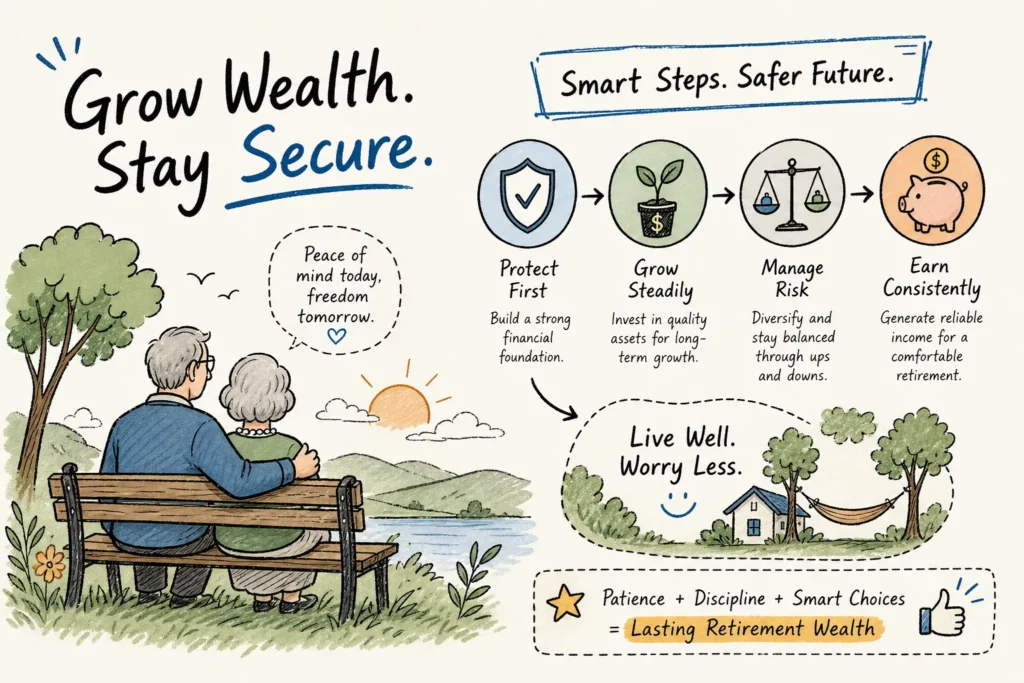
This article covers the best ways to grow retirement wealth without taking excessive risk, not by hiding everything in a fixed deposit account, but by building a portfolio that earns meaningful, consistent returns while keeping volatility tightly managed. At CF Lieu, we regularly work with professionals who are surprised to discover that a well-structured conservative portfolio can deliver 4, 6% annually, based on a combination of EPF, higher-grade bonds, dividend ETFs, and REITs, with far fewer sleepless nights than a high-growth equity strategy. The following strategies explain exactly how that works, and what instruments make it possible for Malaysian investors.
Table of Contents
Why risk-adjusted returns matter more than raw performance in retirement
Two portfolios with identical average annual returns can produce vastly different retirement outcomes depending on when the losses occur, a concept known as sequence-of-returns risk. A retiree drawing down 4% per year while their portfolio drops 20% in year one faces a permanently impaired base. The compounding that saved them during accumulation now works against them: each subsequent withdrawal is a larger percentage of a smaller portfolio, and recovery becomes structurally harder the longer you wait.
Malaysian retirees face a particularly challenging version of this problem. With a 30, 35-year retirement horizon becoming standard, and medical inflation running well above headline CPI, the traditional 4% withdrawal rule, derived from US market data, is simply too aggressive here. A more appropriate starting point for a Malaysian retiree is a 3.0, 3.5% withdrawal rate, giving the portfolio enough buffer to survive a poor sequence of early returns without permanent damage. This figure is consistent with emerging-market safe withdrawal rate research, which accounts for higher local market volatility and longer planning horizons.
Local equity data reinforces this point. The FBM KLCI delivered roughly 6, 7% total annual return over the past decade, but the price return alone was only around 2.8% per year, with dividends accounting for the rest. Emerging markets like Malaysia also carry higher year-to-year volatility than developed markets. This is not an argument against equities. It is an argument against being over-allocated to them at or near retirement, when time is no longer on your side.
Best ways to grow retirement wealth without taking excessive risk: building the right portfolio
A risk-conscious investor in their 50s should not have 80% of their wealth in equities, this is an advisory starting point, not a universal rule, and the right allocation depends on individual circumstances. A more suitable framework for a pre-retiree might allocate 30, 50% to equities (split between Malaysian dividend stocks and global index ETFs), 30, 40% to fixed income (bonds and EPF), and 10, 20% to alternative stabilisers such as REITs or gold. The precise split depends on years to retirement, expected monthly income needs, and existing EPF balances, but the goal is consistent: narrow the gap between what a good year and a bad year do to your spending power. If you are a high-earning professional with complex needs, consider reviewing specialised retirement planning strategies for high-income professionals to tailor the allocation to your cashflow requirements.
Many investors also confuse two distinct concepts: volatility tolerance and risk capacity. Tolerance describes how much short-term fluctuation you feel comfortable watching on a screen. Capacity describes how much volatility your actual financial plan can absorb before it fails. A professional with RM1.2 million saved and a monthly income target of RM5,000 has a very different capacity from one targeting RM10,000. Conservative retirement strategies are not one-size-fits-all; they are calibrated to your specific numbers and your specific timeline.
Dividend income strategies that build consistent cash flow
Dividend-focused investing gives retirees something that growth portfolios rarely do: regular income without forced asset sales. For Malaysian investors, this takes several practical forms. Locally listed options include the EQ8MID (Eq8 MSCI Malaysia Islamic Dividend ETF), which carries a roughly 3.25% trailing yield at a 0.50% expense ratio, and the WAQF-EA ETF for investors with Shariah-compliance requirements.
For those with international brokerage access, SCHD (Schwab U.S. Dividend Equity ETF) offers approximately 3.5% yield at a notably low 0.06% expense ratio, making it a cost-efficient dividend vehicle. Individual Malaysian dividend stocks in banking, utilities, and telecommunications can complement these ETF positions. It is worth noting that SCHD is US-listed, so Malaysian investors should consider the currency exposure and applicable withholding tax implications before investing.
The more important discipline is prioritising dividend growth over headline yield. As an illustrative example, a company that raises its payout by 5, 6% annually provides an inflation hedge that a static 7% yielder does not. Over a 30-year retirement, a growing income stream is worth significantly more than a high initial yield that stagnates. The sustainable retirement income goal is not the highest number you can find today; it is a reliable, growing cash flow that replaces employment income without forcing you to liquidate assets during a market downturn.
Bond laddering, a practical way to grow retirement wealth with low risk
Bond laddering involves purchasing fixed-income instruments with staggered maturities, for example, bonds maturing in 1, 3, 5, 7, and 10 years. When each rung matures, the investor receives the principal back, which can be used for living expenses or reinvested into a new long-dated bond at prevailing rates. This structure removes the pressure of timing the market and shields the portfolio from the interest rate risk that comes with holding a single-maturity bond position. For anyone within a decade of retirement, it is one of the most practical capital preservation tools available.
As of mid-2026, Malaysian Government Securities (MGS) yields sit at approximately 3.26% for the 3-year, 3.40% for the 5-year, and 3.63% for the 10-year tenor, giving Malaysian retirees a workable foundation for a ladder. These figures are sourced from published yield data and represent a point-in-time snapshot rather than a guaranteed forward return. For current yield curves and historical context on government bond yields, refer to the Malaysia government bond yields data.
For retail investors who want diversified local bond exposure without institutional minimums, the ABF Malaysia Bond Index Fund (ABFMY1), listed on Bursa Malaysia, is a practical building block. Retail access to bonds has also expanded through platforms such as FSM1 Bond Express and Bursa’s Exchange Traded Bonds and Sukuk (ETBS) market, where minimum investments start from as little as RM1,000 per position, details available directly through the respective platforms.
EPF, PRS, and alternative assets as portfolio stabilisers
EPF remains the single most compelling low-risk retirement investment available to most Malaysians, and it is frequently underappreciated. The 2025 dividend of 6.15% was earned with zero management fees and is fully tax-exempt. When a PRS growth fund charging 1.7, 2.5% in annual fees needs to generate 8, 9% gross returns just to match EPF’s net 6.15%, the comparison becomes stark. Industry data consistently suggests that a significant proportion of PRS funds fail to outperform EPF before sales charges, and that figure drops further after fees are factored in. EPF’s liquidity structure, which allows 30% withdrawal at age 50 and full access at 55, is a feature for retirement planning, not a limitation. For more on historical EPF performance, see this summary of historical EPF dividend rates.
PRS does have a place in a well-structured plan, primarily as a tax optimisation tool. The annual tax relief of up to RM3,000 is real and worth capturing, particularly for higher-income earners, refer to the current LHDN income tax schedule to identify whether your bracket makes this meaningful. The key is selecting lower-fee funds and treating PRS as a complement to EPF rather than a replacement.
As for alternative assets, Malaysian REITs currently yield between 5, 6.26% on Bursa, providing dividend income alongside moderate capital growth, this is a current market snapshot and should be verified against live data. Gold, accessible through ETFs such as GLD (US-listed, with currency and ownership implications for Malaysian investors) or local gold savings accounts offered by banks such as Maybank and Public Bank, acts as a hedge against currency depreciation and market stress. Neither REITs nor gold should dominate a conservative allocation, but a combined 10, 15% weighting in these assets can meaningfully smooth returns across a full market cycle.
Why a flat-fee advisor gives you a cleaner, unbiased starting point
Many financial products marketed to retirees are sold rather than chosen. A commission-based advisor earns more when you purchase a higher-premium investment-linked policy or a PRS fund with a 2% management fee than when you simply optimise your existing EPF strategy and build a low-cost ETF ladder. This is a structural issue built into commission-driven business models, one that Malaysian industry observers have noted for some time. For an investor specifically seeking the best ways to grow retirement wealth without taking excessive risk, the advice you receive is only as unbiased as the incentive structure behind it.
CF Lieu operates on a flat-fee, commission-free model, which means every recommendation is driven by your numbers and your goals rather than product margins. A typical engagement begins with a cashflow stress-test: identifying how much your current portfolio can sustain at a 3.0, 3.5% withdrawal rate, stress-tested against a poor sequence of early returns. This is followed by a recommended asset allocation across EPF, fixed income, dividend-focused equities, and low-volatility ETFs, sized precisely to your income target and timeline. To explore how to put these principles into action, you may also find useful guidance in our piece on Maximizing Your Retirement Investment in Malaysia. The outcome is a retirement roadmap you can act on immediately, without being steered toward high-commission products that serve the advisor more than the investor.
The practical next step
Growing retirement wealth safely comes down to one discipline: choosing strategies that deliver consistent, risk-adjusted returns across a 30, 35-year horizon rather than maximising raw performance in any single year. The best ways to grow retirement wealth without taking excessive risk, for Malaysian investors, typically combine EPF optimisation, a dividend income layer, bond laddering for predictable cash flow, and selective exposure to REITs or gold as stabilisers, all sized according to your personal withdrawal needs and timeline. These are not complex instruments; they are low-risk retirement investments that work together to preserve your capital while keeping your income growing.
The most useful action you can take right now is to stress-test your current portfolio against a realistic withdrawal scenario. Run the numbers at 3.0, 3.5%, consistent with emerging-market safe withdrawal rate research, and see how long your savings last under a conservative market assumption. If that exercise raises more questions than it answers, a professional second opinion can provide the clarity you need to move forward with confidence. Book a free retirement planning assessment with CF Lieu to find out exactly where your retirement portfolio stands today, and what it would take to make it last as long as you need it to. Slots are limited each month, so reach out early to secure your session.
➡️ 10 Questions to assess your Financial Readiness Test for Retirement / Career Break:
➡️ Want a licensed advisor to independently plan, validate, and optimize your early retirement numbers without the sales talk?
Here to schedule an assessment call
▶️ Or want to run the numbers yourself without talking to anyone?
Tap Here to quickly use our web app to build and stress-test your retirement roadmap in the next 5 min
FAQs: Retirement Investing for Risk Conscious Investors
What is sequence-of-returns risk and why does it matter for retirees?
Sequence-of-returns risk is the danger that large losses early in retirement permanently reduce the portfolio base because you are drawing down rather than accumulating. The article illustrates that a 4% withdrawal when the portfolio falls 20% in year one makes recovery much harder, since each withdrawal becomes a larger share of a smaller portfolio.
What safe withdrawal rate should Malaysian retirees use?
The article recommends a more conservative starting point of about 3.0–3.5% for Malaysian retirees, noting the traditional 4% withdrawal rule is derived from US data and is likely too aggressive here. This lower figure aligns with emerging-market safe withdrawal-rate research and practical guidance like Morningstar’s review of safe withdrawal rates.
How can I grow retirement wealth without taking excessive risk?
Build a diversified conservative portfolio that earns consistent returns while limiting volatility, using instruments such as EPF, higher-grade bonds, dividend ETFs, and REITs. CF Lieu finds well-structured conservative portfolios can deliver roughly 4–6% annually with far fewer sleepless nights than a high-growth equity strategy.
What asset allocation is recommended for a risk-conscious investor in their 50s?
A suggested starting framework is 30–50% equities (split between Malaysian dividend stocks and global index ETFs), 30–40% fixed income (bonds and EPF), and 10–20% alternative stabilisers like REITs or gold. The article emphasises this is an advisory starting point and the exact split should reflect years to retirement, income needs, and existing EPF balances.
Can conservative portfolios outperform fixed deposits in Malaysia?
Yes — the article argues you don’t need to hide everything in fixed deposits to be safe; a conservative portfolio combining EPF, higher-grade bonds, dividend ETFs, and REITs can produce meaningful, consistent returns in the 4–6% range. That approach aims to balance return and volatility rather than chasing raw performance.
How should I treat equities as I approach or enter retirement?
Equities are not ruled out, but the article warns against being over-allocated to them at or near retirement because emerging markets like Malaysia have higher year-to-year volatility. For context, the FBM KLCI delivered roughly 6–7% total annual return over the past decade, but price return was only about 2.8% per year with dividends accounting for much of the rest, so equity exposure should be managed carefully.
What is the difference between volatility tolerance and risk capacity?
Volatility tolerance is your emotional willingness to endure portfolio swings, while risk capacity is your financial ability to take risk given your time horizon, income needs, and withdrawal plan. The article cautions investors not to confuse the two when setting retirement allocations.