Nearly half of EPF contributors arrive at age 55 with less than RM10,000 in savings, according to EPF’s own published data. That figure exists alongside a widespread assumption among many Malaysian professionals that they are roughly on track, and it is precisely that gap between assumption and reality where retirement plans most commonly collapse. If you have ever wondered how to create a retirement roadmap step by step, this article gives you a practical, structured answer.
A retirement roadmap fixes that gap by giving you a structured, living document rather than a vague intention. It is not a one-time calculation you file away; it is a framework you update as your life changes. This step-by-step retirement guide mirrors the structured approach used in retirement roadmapping engagements at CF Lieu, Wealth Advisor, an independent fee-only financial planning practice based in Malaysia. By the end, you will have the tools to produce a first draft of your own personalised roadmap covering your income needs, projected income sources, savings gap, investment strategy, and review milestones.
Table of Contents
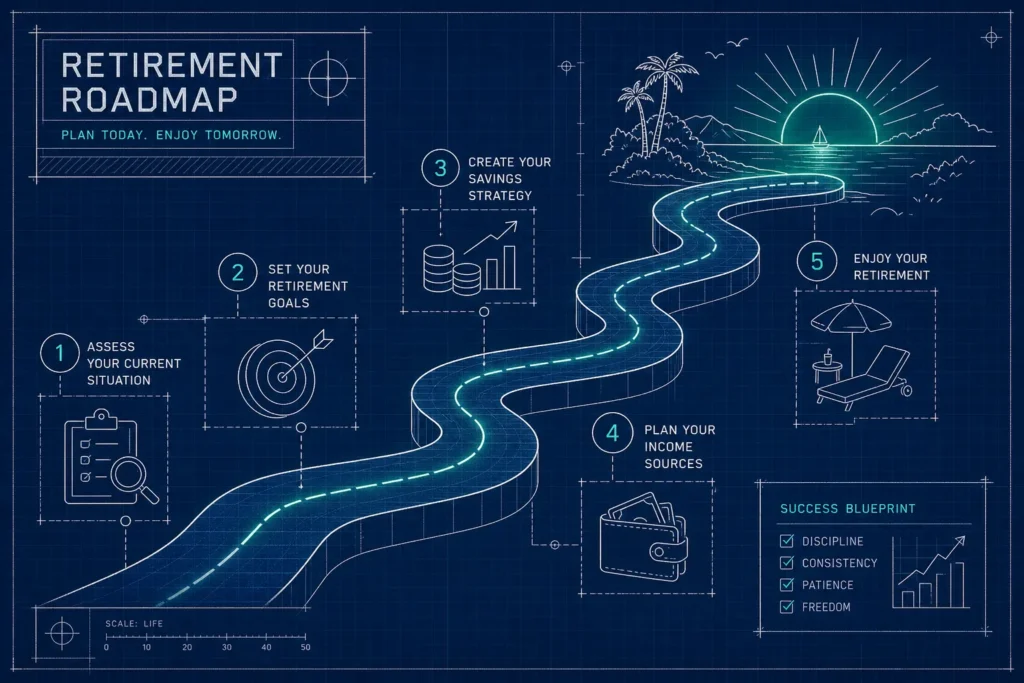
How to create a retirement roadmap step by step, an overview
Before diving into each step, it helps to see the full retirement timeline at a glance. The process moves in five connected stages: calculating how much income you need, listing every source of post-retirement income, finding the savings gap, aligning your investments with your timeline, and stress-testing the plan. Each stage builds on the one before it. A retirement checklist sits at the end of this guide to help you track progress.
Step 1: Calculate how much retirement income you actually need
How to set your retirement income target
The most widely used starting benchmark is the 70, 80% income replacement rule: in retirement, most professionals need roughly 70 to 80 per cent of their current income to maintain a comparable standard of living. This accounts for the reduction in commuting costs and work-related expenses, while still covering lifestyle spending, travel, and the gradual rise in healthcare needs.
Once you have that monthly figure, the “25 times annual expenses” rule gives you the corresponding lump sum target. If your household currently spends RM6,000 per month (RM72,000 annually), your inflation-adjusted retirement budget might be around RM5,000 to RM5,500 per month. Multiply that annual figure by 25 and you arrive at a rough nest egg target of RM1.5 million to RM1.65 million. That single number anchors everything else on your retirement goals roadmap.
Why your retirement age changes everything
Retiring at 55 instead of 65 has a compounding effect that most people underestimate. Fewer accumulation years means a smaller portfolio at the starting line; more withdrawal years means the portfolio must work harder for longer. For someone retiring at 60, planning for a retirement runway that extends to age 85 or 90 is not pessimistic, it is prudent. According to the Department of Statistics Malaysia, males retiring at 60 can expect to live approximately 18 more years on average, but that is just the midpoint. Half of retirees will live longer, and a 25 to 30-year horizon is a far safer assumption than 15 years.
Accounting for Malaysian healthcare and living costs
A couple living independently in the early retirement years spends roughly RM3,000 to RM3,100 per month on basic living costs, based on EPF cost-of-living estimates. That figure rises as care needs increase, with assisted living adding RM1,000 to RM5,000 per month for room and care services alone. Healthcare costs must be budgeted as a separate line item rather than folded into general living expenses.
The inflation risk here is significant. Medical cost inflation in Malaysia has historically run at 10 to 15 per cent per year according to industry surveys, far above general consumer price inflation. Private medical insurance for a couple in their early 60s already runs RM3,500 to RM5,300 or more per year, based on insurer rate surveys, with premiums rising sharply with age. Build a specific healthcare budget into your retirement income target from the outset.
Step 2: List every post-retirement income source you have
EPF, employer pensions, and KWSP planning
Start with your EPF balance, which you can check via the i-Akaun app. Use EPF’s built-in Retirement Goal Calculator to project monthly withdrawals based on your savings level. The reference benchmarks for age 60, drawn from EPF’s Retirement Income Adequacy (RIA) Framework, are worth knowing: Basic Savings of RM390,000 supports a modest monthly withdrawal, Adequate Savings of RM660,000 provides a more comfortable drawdown, and Enhanced Savings of RM1.3 million offers a significantly higher monthly income over a 20-year period. If your employer offers a defined-benefit pension scheme, contact HR for the projected monthly pension amount and add it to your income inventory.
Investments, rental income, and part-time work
For an investment portfolio, a straightforward way to estimate monthly income is: portfolio value multiplied by your expected dividend yield, divided by 12. A RM300,000 portfolio at a 5% yield produces approximately RM1,250 per month. For rental properties, use net rent rather than gross rent by subtracting maintenance, agent fees, and taxes from the monthly rental figure.
Part-time or consulting income belongs on the roadmap too, but model it conservatively. It is a variable source that may not be available throughout retirement, so treat it as a supplement rather than a foundation. Once you have all figures in hand, total them into a single projected monthly retirement income.
Step 3: Find your savings gap and set a concrete target
The retirement income gap formula
The gap calculation is straightforward: monthly retirement income needed, minus total projected monthly income from all sources, equals your monthly shortfall. If you need RM6,000 per month and your EPF, investments, and rental income produce RM3,500 combined, the shortfall is RM2,500 per month or RM30,000 per year. To find the additional portfolio required to fund that gap, divide the annual shortfall by your withdrawal rate. Using a conservative 3.5% rate suited to the Malaysian context, RM30,000 divided by 0.035 gives you a gap-funding target of approximately RM857,000.
The gap figure is a starting point for action, not a final verdict. Many professionals discover at this stage that the number is entirely manageable with modest adjustments to their savings rate or retirement timing, and that knowledge alone makes the exercise worthwhile.
Turning the gap into a monthly savings target
Once the total gap figure is clear, you work backwards: how much do you need to save and invest each month from now until retirement to close it, assuming a realistic investment return? For Malaysian planning purposes, a 3% annual inflation assumption and a 6% pre-retirement portfolio return are reasonable defaults.
Step 4: Align your investment strategy with your retirement timeline
Asset allocation by stage of life
Investment allocation should shift deliberately over time. In the growth phase covering your 20s to 40s, a portfolio weighted 70 to 95% towards equities captures compounding returns over decades and has sufficient time to recover from market downturns.
Through the 50s, the portfolio transitions towards a 60/40 or 70/30 stocks-to-bonds mix, reducing volatility while maintaining enough equity exposure to stay ahead of inflation. In the final five years before retirement, the priority shifts to capital preservation: a defensive allocation of 30 to 40% equities, with the remainder in bonds, fixed deposits, and cash equivalents, an approach aligned with sequence-of-returns risk management. Within each stage, diversification across unit trusts, REITs, dividend-paying stocks, and fixed income instruments reduces concentration risk.
Protecting your capital as retirement approaches
Sequence-of-returns risk is the specific danger that a severe market downturn in the first few years of drawing down a portfolio can permanently impair its longevity, even if markets recover fully later. The practical mitigation is a two to five year cash buffer built before you retire, conservative guidance favours the higher end of that range, so the portfolio is never forced to sell depreciating assets to fund living expenses. At RM6,000 per month in expenses, a four-year buffer means keeping approximately RM288,000 in liquid, low-risk instruments before the retirement date.
Maintaining 30 to 40% in equities even during retirement remains important. Over a 25 to 30-year horizon, inflation will erode purchasing power significantly unless the portfolio continues to grow. Annual rebalancing keeps the allocation on track without requiring reactive decisions during periods of market stress.
Step 5: Stress-test your roadmap before you depend on it
Three scenarios every retirement plan should survive
Any plan that holds up only under ideal conditions is not truly a plan. Run your numbers through at least three stress scenarios before treating the roadmap as reliable.
- Longer life: What happens if you live to 95 instead of 85? An extra decade of withdrawals at RM6,000 per month adds RM720,000 in cumulative spending. Does the portfolio last?
- Higher healthcare costs: What if you need assisted living for five years at RM3,370 to RM5,000 per month? Add that figure to the plan and check whether the portfolio survives.
- Lower-than-expected returns: What if your portfolio grows at 4% instead of 6% for a decade? Recalculate the monthly savings target under that scenario and see how much the gap widens.
Setting your retirement review schedule
A retirement roadmap needs revisiting whenever life changes: a salary increase, a new property, marriage, children, or a health event all shift the numbers. At minimum, schedule a formal annual review to update your net worth, check progress against savings milestones, and rebalance the portfolio.
For a mid-career professional, key checkpoint ages are 40, 45, 50, 55, and 60. These intervals reflect meaningful transitions in earning capacity, family obligations, and proximity to retirement, each one an opportunity to confirm the roadmap still reflects your current situation and goals rather than the assumptions you made years earlier.
When your self-built plan needs a professional second opinion
Signs your retirement roadmap has blind spots
Some retirement situations are straightforward; others are not. If you hold multiple investment accounts across EPF, PRS, unit trusts, and direct equities with no unified strategy, each individual statement may look fine while the overall portfolio carries structural gaps. If you are uncertain whether your insurance coverage accounts for rising private healthcare costs in your 70s, a separate assessment is worth pursuing. Specialists who work with practitioners often publish targeted guides, if you are a medical professional, consider reviewing tailored roadmapping resources such as Retirement Roadmapping & Scenario Analysis using AI (Malaysian Medical Professionals) | CF Lieu.
If your income picture involves a business, rental properties, or overseas assets that a standard calculator cannot model accurately, the plan carries more risk than it appears to on paper. A nagging sense that the numbers look reasonable but have never been tested by someone who does this professionally is itself a signal worth acting on. Business owners may find a dedicated roadmapping engagement useful; see Retirement Roadmapping & Scenario Analysis using AI (Business Owners) | CF Lieu for the specialised approach.
How a fee-only roadmapping engagement works
A personalised retirement roadmapping engagement at CF Lieu, Wealth Advisor covers the full framework in structured form: a review of your current assets and liabilities, an income source mapping exercise, a gap analysis, investment strategy alignment, and a written plan you leave with. Because CF Lieu operates on a flat-fee, commission-free basis, the advice is not shaped by any product sale or fund recommendation. There are no hidden incentives, the sole objective is an accurate, sustainable plan built around your specific circumstances. If your situation includes mortgage planning or multiple property loans, the mortgage-focused process described in Retirement Roadmapping & Scenario Analysis using AI (Malaysian with Mortgages) | CF Lieu may be directly relevant.
An initial consultation is available for those who want to understand the process before committing. The goal is not to replace the self-built plan you arrive with, but to validate it, sharpen it, and surface anything you may have missed.
Your retirement roadmap starts today
Building a retirement roadmap comes down to five connected steps: calculating your income needs, listing your income sources, finding the savings gap, aligning your investments with your timeline, and stress-testing the plan against realistic scenarios. The precision of the numbers at the start matters far less than the discipline of having a structured framework that gets refined over time.
A roadmap built today with rough estimates is far more valuable than a perfect plan that never gets written. If you have worked through these steps and want to understand how to create a retirement roadmap step by step with an experienced professional reviewing the result, CF Lieu, Wealth Advisor offers an independent, fee-only engagement designed for exactly that purpose. A well-constructed retirement roadmap delivers one concrete outcome: the clarity to make financial decisions today from an informed position rather than an assumed one.
Retirement planning checklist
☐ Schedule your next annual review and note your next checkpoint age
☐ Set your monthly retirement income target using the 70, 80% income replacement rule
☐ Calculate your nest egg target using the 25× annual expenses formula
☐ Log in to i-Akaun and note your current EPF balance and projected drawdown
☐ List all other income sources: pensions, PRS, investments, rental, part-time work
☐ Calculate your monthly shortfall and gap-funding target
☐ Set a monthly savings target using a retirement budget calculator
☐ Review your asset allocation against your current life stage
☐ Confirm your cash buffer is sufficient for two to five years of expenses
☐ Run at least three stress-test scenarios
FAQs: Create a Retirement Roadmap
What is a retirement roadmap and why do I need one?
A retirement roadmap is a structured, living document that replaces vague intentions with a step-by-step plan covering income needs, projected income sources, savings gap, investment strategy, and review milestones. The article notes many Malaysian professionals overestimate their readiness—EPF data shows nearly half of contributors reach age 55 with less than RM10,000—so a roadmap fixes the gap between assumption and reality.
How do I calculate how much retirement income I will need?
Start with an income replacement target using the 70–80% rule of your current income to estimate monthly retirement spending, then convert that to a lump-sum goal using the “25 times annual expenses” rule. For example, if your household spends RM6,000 per month now, a conservative retirement budget might be RM5,000–5,500 per month, implying a nest egg target of about RM1.5 million–RM1.65 million.
What five stages should I follow when creating a retirement roadmap?
The process moves through five connected stages: calculate how much retirement income you need; list every source of post-retirement income; find the savings gap; align your investments with your timeline; and stress-test the plan. Each stage builds on the previous one and the guide ends with a checklist to track progress.
How does my retirement age change the size of the nest egg I need?
Retiring earlier (for example at 55 instead of 65) reduces accumulation years and increases withdrawal years, so your portfolio must be larger or work harder for longer. The article recommends planning for a 25–30 year retirement horizon (rather than a 15-year assumption), noting Department of Statistics Malaysia life expectancy data and the risk of outliving a smaller portfolio.
How should I budget for healthcare and assisted living costs in Malaysia?
Treat healthcare as a separate line item because medical cost inflation in Malaysia has historically run around 10–15% per year, well above general inflation. The article cites EPF cost-of-living estimates that a couple’s basic early-retirement living costs are about RM3,000–3,100 per month, assisted living can add RM1,000–5,000 per month, and private medical insurance for a couple in their early 60s can run about RM3,500–RM5,300 or more per year.
How do I find my savings gap?
Compare your retirement income target or nest-egg target (for example the 25x annual expenses number) with the total projected retirement resources from all sources and your expected portfolio at retirement. The savings gap is the shortfall between the target and your projected resources, which you then close by increasing savings, extending your working years, or adjusting investments.
How often should I review and update my retirement roadmap?
A retirement roadmap is a living document and should be reviewed regularly whenever major life changes occur—job changes, inheritance, health events, or shifts in spending goals—or at set milestones (for example annually or at five-year intervals). Regular stress-testing against longer lifespans and higher healthcare inflation ensures the plan stays realistic and actionable.